Author: admin

  • Bhubaneswar to Host ‘Shraddhanjali 2026’ — A Musical Tribute to Guru Bauri Bandhu Sethi

    Bhubaneswar, April 30: Delhi-based cultural organization Swaranjali is set to bring an evening of classical music and tribute to Odisha’s capital with Shraddhanjali 2026, a commemorative concert dedicated to Guru Late Suramani Bauri Bandhu Sethi.

    The event will be held on June 20, 2026, at 5 PM at Gita Govinda Sadan, Jayadev Bhawan, Ashok Nagar, Bhubaneswar. Organized in association with Shreyas Webmedia Solutions, the program aims to honor the legacy of the late guru through a curated lineup of classical performances.

    Bhubaneswar to Host ‘Shraddhanjali 2026’ — A Musical Tribute to Guru Bauri Bandhu Sethi


    The evening will feature a group vocal presentation by the disciples of Shri Avimanyu Sahoo from Sishuniketan School, Mancheswar. Instrumental highlights include a sitar and sarod duet by Shri Jeeban Prakash Das and Shri Sandeep Rout. Vocal recital by Smt. Bilambita Banisudha and a solo sitar performance by Shri Subrata De are also part of the program.

    The event will be anchored by Vidwan Shri Alok Das, adding a narrative touch to the musical proceedings.

    Organizers have extended an open invitation to music lovers, patrons of classical arts, and the general public to attend the event and pay tribute to the revered गुरु through music.

    For further details and RSVP, interested attendees may contact 9910300319, 8447507053, or 9937001349.

    Swaranjali, founded by Subrata De, continues to promote Indian classical music through performances and cultural initiatives across the country, in collaboration with partners like Shreyas Webmedia Solutions.

  • WEX® Taps Extend to Enable Corporate Card Payments in SAP Concur Solutions

    WEX brings smarter AP solutions to Corporate Card customers with the help of growing fintech business, Extend.

    NEW YORK–Extend, a leader in embedded virtual card payments, today announced a collaboration with WEX Inc. (NYSE: WEX), a global leader in intelligent payment solutions, to enable virtual card payments inside Concur Invoice. WEX corporate card customers can now connect their WEX commercial account in Concur Invoice to generate and settle vendor payments with virtual cards—all automatically and without leaving the Concur platform.

    As an established SAP Concur partner, Extend provides WEX with the infrastructure key to facilitating—and accelerating—this strategic integration designed to deliver more value to business customers. This news reflects Extend’s growing position as a trusted fintech partner for financial institutions and corporate payment providers looking to deliver embedded payment capabilities inside the platforms their customers already rely on.

    A Seamless Payments Experience for WEX Customers

    For WEX corporate card customers using Concur Invoice, this integration not only enables a new level of control and security over vendor payments, it also means a more streamlined and automated AP process. When an invoice is received, Concur Invoice automatically generates a virtual card linked to the customer’s registered WEX commercial account—complete with a unique 16-digit number, spend limit, validity date, and invoice reference—then authorizes, remits, and reconciles the payment end to end.

    This gives WEX customers the ability to:

    • Settle invoices with single-use virtual cards generated from their existing WEX commercial account

    • Control payment amounts and timing with per-invoice virtual card parameters

    • Pay suppliers faster, improving cash flow, and days payable outstanding

    • Automate reconciliation and gain complete visibility into payment delivery

    • Eliminate paper checks and reduce associated risks and administrative burden

    • Earn available card rebates on vendor transactions

    “WEX is committed to providing our customers with intelligence-led solutions that transform Accounts Payable from a back-office function into a strategic driver of working capital,” said  Carlos Carriedo, Chief Operating Officer, Americas Payments & Mobility, WEX. “By partnering with Extend to embed virtual card payments inside Concur Invoice, we are delivering infrastructure that offers granular control over every transaction, all without disrupting how they already operate.”


    WEX: Optimizing the AP Lifecycle with Virtual Card Technology

    WEX modernizes the entire AP lifecycle through an intelligence-led orchestration layer that replaces vulnerable credentials with single-use virtual tokens that help neutralize fraud at the point of issuance. This digital architecture simplifies complex global payments across countries, currencies and systems to manage virtual cards and process transactions — all on one platform. By combining this transaction processing with strategic supplier enablement and guided enrollment, WEX helps transform Accounts Payable from a traditional cost center into a scalable, value-generating asset.

    Andrew Jamison, CEO and co-founder of Extend, shares “WEX is one of the most respected names in corporate payments, and this partnership reflects the momentum we’re seeing across the industry. Extend has built the infrastructure that lets card issuers and payment platforms deploy new capabilities inside the software their customers already use, without ripping and replacing what’s already working. As customer expectations rapidly evolve, so does the race to deliver more connected payment workflows—Extend is excited to be the partner that makes it possible.”

    Extend: The Embedded Payments Layer for Enterprise

    Extend’s platform sits at the intersection of card rails, spend management, and expense software—connecting legacy payment infrastructure to modern business workflows. With partnerships across major issuing banks, integrations with the three largest card networks, and a growing footprint within solutions like Concur Invoice, Extend has built the connective tissue that allows financial institutions and corporate payment providers to offer new experiences to end users without costly, time-intensive direct integrations.

    As business software platforms and card programs continue to converge, Extend is uniquely positioned to accelerate this shift across the industry. The WEX partnership is the latest example of a leading corporate payment provider leveraging Extend’s infrastructure to move faster, reach more customers, and deliver more value from existing card programs. 

  • etrailer First in St. Charles County to Offer Missouri Child Care Works

    The company is the first in the county to introduce the shared child care support solution for its employees.

    (St. Louis, Mo., April 30, 2026) Child Care Aware of Missouri (CCAMO), in partnership with Kids Win Missouri, recently worked with etrailer to launch the Missouri Child Care Works Tri-Share program. As the first local business to adopt the program, etrailer is expanding access to shared child care support for its workforce.

    Missouri Child Care Works is designed to increase family access to affordable, high-quality child care through locally coordinated cost-sharing partnerships. St. Charles County-based etrailer is bringing this new shared child care support model to its employees. The program is modeled after the Tri-Share approach, which divides the cost of child care among employers, families and either state government or a philanthropic partner.

    etrailer First in St. Charles County to Offer Missouri Child Care Works


    This initiative helps employee families with children age five and under to receive child care support through funding from etrailer and the state. Administered by CCAMO, the employer and state contributions are paid directly to participating child care providers, making the benefit easy to use for etrailer employees.

    etrailer is a family-owned and operated business specializing in RV, trailer and towing accessories. Founded in 1946, the company’s showroom and installation facility is located at 1507 Highway A in Wentzville, Missouri. etrailer.com is the world’s leading online retailer of custom-fit towing accessories.

    “We couldn’t be more excited about the support this program brings to growing families around the shop, and we can’t wait to see where it takes us next,” said Greg McCarthy, Team Enthusiast at etrailer.

    “When employers invest in child care benefits, they play a critical role in removing barriers for families returning to the workforce while strengthening their ability to attract and retain talent,” said Robin Phillips, CEO of Child Care Aware of Missouri. “With full-time child care representing one of the largest expenses for working families, our partnership with etrailer offers a meaningful solution to support employee retention.”

    Founded in 1999, CCAMO is a statewide nonprofit that focuses on a comprehensive early childhood education experience through impactful programs and partnerships. The organization’s services include workforce development, child care business supports, advocacy and policy work, and its new Child Care Keeps Missouri Working, a regional campaign offering concierge solutions to businesses undergoing employee recruitment and retention challenges due to the overwhelming shortage of quality child care options. For more information, call (314) 535-1458 or visit www.mochildcareaware.org.

  • IndiaMART InterMESH Limited releases Q4FY26 and FY26 results, reports consolidated Revenue of Rs. 1569 Crore for the year and Rs 404 crore for the Q4

    Noida, India, Apr 30: IndiaMART InterMESH Limited (referred to as “IndiaMART” or the “Company”), today announced its financial results for the full year and fourth quarter ending March 31, 2026.
     
    Consolidated Financial Highlights (Q4 FY2026):
     
    IndiaMART reported consolidated Revenue from Operations of Rs404 Crore as compared to Rs. 355 Crore in the corresponding quarter of last year, representing a growth of 14%. This includes IndiaMART Standalone Revenue of Rs. 368 Crore, representing YoY growth of 10% and Busy Infotech Revenue of Rs 34 Crore.
     
    Collections from Customer grew to Rs. 595 Crore for the quarter, representing YoY growth of 10%, primarily comprising of IndiaMART Standalone Collections of Rs. 546 Crore representing YoY growth of 8% and Busy Infotech Collections of Rs 45 Crore.
     
    Deferred Revenue as on March 31, 2026 increased to Rs. 1,965 Crore representing a YoY growth of 17%. This primarily includes IndiaMART Standalone Deferred Revenue of Rs. 1,832 Crore and Busy Infotech Deferred Revenue of Rs. 124 Crore.
     
    Net Profit for the quarter was Rs. 50 Crore. Cash Flow from Operations for the quarter was Rs. 290 Crore. Cash and Investments balance stood at Rs. 3,280 Crore as on March 31, 2026.
     
    Standalone Financial Highlights (Q4 FY2026):
     
    Standalone Revenue from Operations increased to Rs. 368 Crore as compared to Rs. 336 Crore last year representing a growth of 10%. The growth was primarily driven by improvement in realization from paying suppliers.
     
    Collections from Customer grew to Rs. 546 Crore for the quarter representing a YoY growth of 8% and Deferred Revenue as on March 31, 2026 increased to Rs. 1,832 Crore representing a YoY growth of 14%.
     
    EBITDA for the quarter was Rs. 135 Crore representing margin of 37%. Net Profit for the quarter was Rs. 69 Crore.
     
    Operational Highlights (Q4 FY2026):
     
    IndiaMART registered Unique business enquiries of 27 million in Q4FY26. Supplier Storefronts grew to 8.7 million, an increase of 5% YoY and paying suppliers at the end of the quarter were 220K.
     
    Commenting on the performance, Mr. Dinesh Agarwal, Chief Executive Officer, said, “We remain focused on driving sustained growth by continuously enhancing platform quality, deepening buyer–seller engagement, and building a more trusted marketplace experience. Our rapid adoption of AI, spanning from standardized cataloging, precise matchmaking results, to conversational AI tools, is making the experience more seamless and efficient. Supported by a resilient business model and strong cash generation, we remain well positioned to deliver long-term value for all stakeholders.”
     
  • EC Introduces QR-Based ID Cards for Counting Centres Ahead of May 4 Vote Count

    Kolkata, Apr 30 (BNP): The Election Commission of India has introduced QR code-based photo identity cards for counting centres to prevent unauthorised entry during vote counting for the Assembly elections in five states on May 4.

    EC Introduces QR-Based ID Cards for Counting Centres Ahead of May 4 Vote Count

    The new system will be implemented during counting of votes for the Assembly polls in West Bengal, Assam, Kerala, Tamil Nadu and Puducherry, along with by-elections in seven Assembly constituencies across five states. Officials said the system will later be extended to all Lok Sabha and Assembly elections nationwide.

    According to the Commission, the QR-based verification system has been developed through the ECINET platform and forms a key part of a newly introduced three-tier security arrangement at counting centres.
    Under the security protocol, identity cards issued by the Returning Officer will be manually checked at the first and second security layers. At the innermost level near the counting halls, entry will be permitted only after successful scanning of the QR code on the authorised identity card.

    The Commission said the move is aimed at eliminating the possibility of unauthorised persons entering sensitive counting areas and ensuring greater transparency, efficiency, and security during the counting process.
    The new identity cards will be applicable to all authorised personnel allowed inside counting centres, including Returning Officers, Assistant Returning Officers, counting staff, technical teams, candidates, election agents, and counting agents.
    Election officials described the initiative as a significant technological upgrade in election management, designed to strengthen the integrity of the counting process and streamline access control on a crucial day of the electoral exercise.

     
  • India Receives 657 Repatriated Antiquities from United States

    New Delhi, Apr 30 (BNP): The United States has returned 657 antiquities, valued at nearly $14 million, to India as part of ongoing efforts to repatriate stolen cultural property.

    US restitutes 657 stolen antiquities to Indiahttps://t.co/qmUZagU6W9

    via NaMo App pic.twitter.com/QMLqfuU0yB

    — PMO India (@PMOIndia) April 30, 2026

    The return was announced by Manhattan District Attorney Alvin Bragg on Tuesday. Officials noted that while the latest handover marks a significant step, further work is needed to trace and recover more smuggled artifacts linked to India’s cultural heritage.

    The repatriated items are believed to include a wide range of historical and cultural objects that were illegally taken out of the country over time. Authorities described the move as part of broader international cooperation aimed at curbing antiquities trafficking and restoring cultural heritage to its country of origin.

    US officials also indicated that efforts to identify and return additional stolen artifacts will continue in coordination with Indian authorities.

    The development has been welcomed as a positive step in strengthening cultural ties and preserving India’s rich historical legacy.

  • CISCE Declares ICSE, ISC 2026 Results; Pass Percentage Above 99 pc, Girls Lead Again!

    New Delhi, Apr 30 (BNP): The Council for the Indian School Certificate Examinations (CISCE) on Thursday announced the results of the ICSE (Class 10) and ISC (Class 12) board examinations for 2026, with the overall pass percentage crossing 99 percent in both categories.

    CISCE Declares ICSE, ISC 2026 Results; Pass Percentage Above 99%, Girls Lead Again!

    The results brought cheer to lakhs of students and parents across the country, with girls once again outperforming boys in overall performance.

    According to official figures, the ICSE Class 10 examinations recorded an impressive pass percentage above 99 percent, while the ISC Class 12 results also maintained a similarly high success rate.

    Girls registered a higher pass percentage than boys in both examinations, continuing the trend of strong academic achievement seen in recent years. Education experts said the consistent performance reflects disciplined preparation and sustained academic standards across affiliated schools.

    Students can access their scorecards through the official CISCE websites and authorised digital platforms. The council has also opened provisions for rechecking, improvement examinations, and other post-result services as per board norms.

    School authorities and parents congratulated successful candidates, while students are now expected to begin preparations for higher secondary admissions, undergraduate courses, and various competitive entrance examinations.

    The declaration of the 2026 board results marks an important milestone for students as they move toward the next phase of their academic and professional journeys.

  • India Begins Consultation on V2X Regulatory Framework: TRAI

    New Delhi, Apr 30 (BNP): The Telecom Regulatory Authority of India (TRAI) has released a consultation paper on establishing a regulatory framework for Vehicle-to-Everything (V2X) communication, marking a step toward enabling advanced connected mobility in India.

    The move follows a reference from the Department of Telecommunications (DoT), under the Ministry of Communications, which on December 1, 2025, requested TRAI to provide recommendations on the regulatory mechanism for V2X technology.

    According to the Ministry, the consultation paper has been made available on TRAI’s official website, and stakeholders have been invited to share their views. The deadline for submitting written comments is May 28, 2026, while counter-comments can be submitted until June 11, 2026.

    Stakeholders have been advised to submit feedback, preferably in electronic form, to TRAI’s Advisor for Networks, Spectrum & Licensing.

    V2X (Vehicle-to-Everything) communication is a wireless technology that allows vehicles to exchange real-time data with other vehicles, road infrastructure, pedestrians, and networks. The system is designed to enhance road safety, improve traffic management, and support the development of autonomous driving by sharing critical information such as speed, location, and road conditions.

    Industry reports indicate that India is emerging as one of the fastest-growing markets for connected vehicles, recording strong year-on-year growth in 2024, driven by increased integration of smart connectivity features by automakers.

    Globally, adoption of connected vehicles is rising steadily, with a large share of new passenger cars already featuring embedded connectivity. The trend is expected to accelerate further with the expansion of 5G networks, which will improve V2X capabilities, enable faster data exchange, and support advanced autonomous driving technologies in the coming years.

  • India Used-Car Market Poised for Strong Growth

    India Used-Car Market Poised for Strong Growth

    New Delhi, Apr 30 (BNP): India’s used-car market is expected to grow significantly over the next few years, nearly doubling to around $70 billion by FY31 from about $35 billion in FY26, driven by rising affordability, faster vehicle replacement cycles, and growing formalisation of the sector, according to a new report.

    The report by Redseer Strategy Consultants notes that India is currently the fifth-largest used-car market in the world and is likely to become the third-largest by the end of the decade, after the United States and China.

    Annual used-car sales are projected to rise to nearly 10 million units by FY31, supported by strong demand, increasing car ownership, and improved financing options.

    A key trend highlighted in the report is the shortening of vehicle replacement cycles, which is expected to fall from 7–8 years in FY21 to around 4–5 years by FY31, especially in metro cities and Tier 1 markets.

    The report adds that rising incomes, growing preference for better-equipped vehicles, and easier access to loans are helping both demand and supply in the used-car ecosystem. Financing penetration is also expected to increase to around 40% by FY31, making cars more affordable for a larger population.

    At present, about 80% of used-car transactions in India still take place in the unorganised sector. However, the market is gradually shifting towards organised, trust-driven platforms that offer better transparency and quality assurance.

    The report also points out that around 65% of used-car buyers are first-time owners, showing how the segment is playing a key role in expanding personal mobility across the country.

    India’s used-to-new car ratio currently stands at 1.4 and is expected to improve to 1.7 by FY31, though it still remains below levels seen in more mature global markets, indicating strong room for further growth.

  • International Tourists Contribute Up to 45% of Airport Retail Spending, IRHPL Report Finds

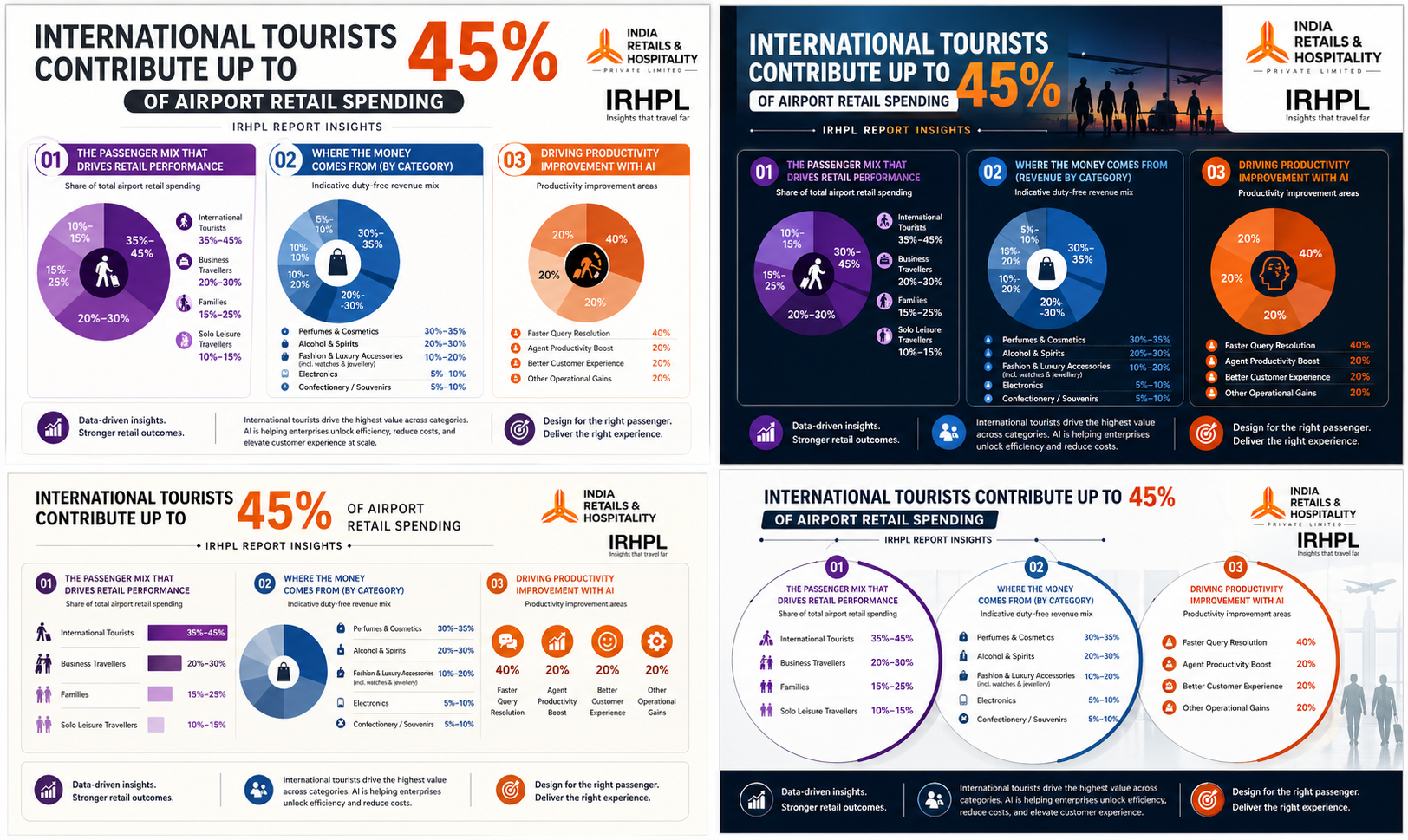
    New Delhi, Apr 30: India Retails and Hospitality Private Limited (IRHPL) has released a new trend report highlighting that international tourists contribute an estimated 35% to 45% of total airport retail spending, making them the most influential segment in travel retail.

    International Tourists Contribute Up to 45% of Airport Retail Spending, IRHPL Report Finds

    The report underscores that airport retail performance is shaped not just by passenger footfall, but by traveller mix, dwell time, and category preferences. International passengers, in particular, drive higher basket values and dominate premium categories such as duty-free, luxury goods, and gifting, thereby contributing disproportionately to overall retail value.

    Passenger Segments and Spending Behavior

    According to IRHPL, airport retail spending is broadly distributed across four key traveller segments:

    • International tourists: 35–45%
    • Business travellers: 20–30%
    • Families: 15–25%
    • Solo leisure travellers: 10–15%

    Each segment exhibits distinct purchasing behavior. International travellers are more inclined toward duty-free and luxury purchases, while business travellers focus on convenience, quick F&B, and select premium items. Families and leisure travellers primarily contribute to everyday categories such as food, essentials, and gifting.

    Key Revenue Categories

    The report identifies perfumes and cosmetics as the leading category in airport retail, contributing around 30–35% of duty-free revenue, followed by alcohol and spirits (20–30%) and fashion and luxury accessories (10–20%). Other contributing segments include electronics, confectionery, souvenirs, and travel essentials.

    Food and beverage (F&B) remains a consistent revenue driver, with grab-and-go formats accounting for 50–65% of spending, dine-in meals contributing 25–35%, and premium beverages making up 10–15%.

    Shopping Trends and Consumer Behavior

    IRHPL’s findings challenge the perception that airport shopping is largely impulse-driven. Instead, 65–75% of purchases are pre-planned, including pre-orders, while impulse buying accounts for 25–35%, mainly in categories such as confectionery, perfumes, and spirits.

    A typical spend mix indicates:

    • Luxury goods: 20–35%
    • Essentials: 25–35%
    • Gifting items: 20–30%

    This balance highlights the need for a diversified retail strategy that caters to both high-value and everyday purchases.

    Industry Insights and Outlook

    Commenting on the findings, Naresh Sharma, CEO of IRHPL Group of Companies, said,

    “Airport retail is no longer a footfall game; it is a passenger-mix game. International travellers bring higher intent, higher basket value, and stronger premium conversion. The opportunity lies in designing retail ecosystems around how these passengers actually spend.”

    The report also notes that 30–60% of international passengers typically make at least one duty-free purchase, with a baseline of 40–50% considered standard for major hubs.

    Looking ahead, IRHPL expects airport retail to grow steadily, with travel and retail expansion projected at 15–20% over the next two to three years. Overall airport retail spending is anticipated to grow in the range of 6–12% year-on-year, depending on market dynamics.

    Conclusion

    The report emphasizes that airport retail is fundamentally a passenger behavior-driven business. With international tourists contributing up to 45% of total retail value, airports and operators must align their strategies to cater to this high-value segment, ensuring a balanced mix of luxury, convenience, and experiential offerings.

    Business News For Profit