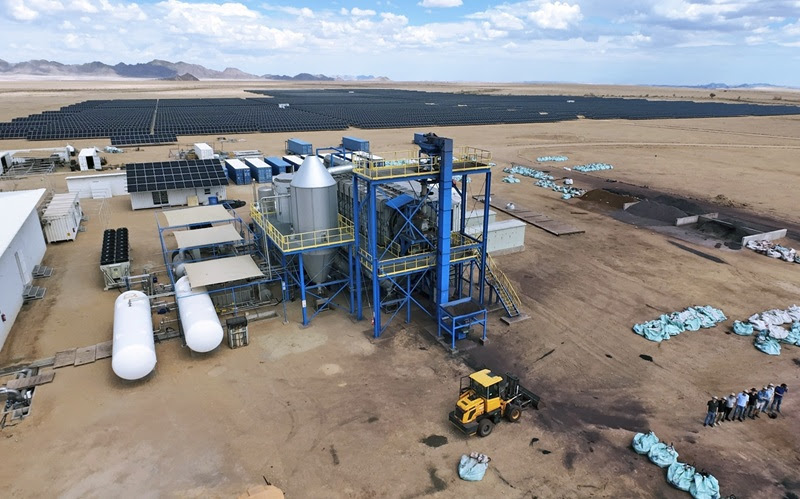
The hydrogen rotary kiln in Oshivela, Namibia. Photo: HyIron.
Berlin, 13.04.2026. In 2025, the international SuSteelAG consortium – led by Federal Institute for Materials Research and Testing (BAM) – launched its mission to decarbonize steel production using hydrogen, including when working with lower‑grade ores. Now, the first industrial‑scale pilot test has been successfully completed in Namibia: In an electrically powered hydrogen rotary kiln, 80 tonnes of Australian iron ore were converted climate‑neutrally into direct‑reduced iron (DRI). With this, SuSteelAG is paving the way for a sustainable value chain linking Australia, Namibia, and Germany -from iron production and refinement to green steel.
The steel industry accounts for around seven percent of global CO₂ emissions; transforming it is therefore a central lever of the energy transition. This is where the SuSteelAG project (Sustainable Steel from Australia and Germany) comes in: Coordinated by BAM, the project is developing a hydrogen‑based direct‑reduction process that, for the first time, can also utilize lower‑grade ores – thereby expanding the resource base available for green steel production.
Until now, climate‑neutral steel production has only been feasible using premium ores with an iron content of roughly 70 percent. These ores, however, are scarce and expensive worldwide. Moreover, existing processes require the use of a shaft furnace, which in turn demands cost‑ and energy‑intensive pelletizing of the ore.
In early April 2026, for the first time, untreated Australian iron ore with a comparatively low iron content (~56 percent) was processed into direct‑reduced iron at industrial scale at the Oshivela site in Namibia, where project partner HyIron Green Technologies operates an innovative hydrogen rotary kiln.
For the campaign, 80 tonnes of iron ore supplied by Australian mining and technology company Fortescue – also a SuSteelAG partner – were available. The German industrial furnace manufacturer TS Elino GmbH was primarily responsible for designing and constructing the rotary kiln. Prior to the industrial trial, BAM had extensively studied hydrogen‑based iron reduction at laboratory scale and derived the optimal operating parameters for the large‑scale process. Based on these findings, the Oshivela plant succeeded in refining the Australian ore into iron under climate‑neutral conditions and with a throughput of approximately five tonnes per hour.
“We have now reached a scale that is highly relevant for industrial production and demonstrated that hydrogen‑based direct reduction of lower‑grade ores can be operated economically – an essential step toward accelerating green steel production in Germany and beyond,” says Christian Adam (BAM), who coordinates the international SuSteelAG consortium. “This also means that green steel production need not be constrained by the limited availability of premium ores.”
The next step will be to ship the refined iron from Namibia to Germany. Salzgitter Mannesmann Forschung GmbH will investigate how the refined iron can best be integrated into existing industrial processes in order to eventually produce climate‑friendly steel for cars and other key products.
RWTH Aachen University (Advanced Mineral Processing Technologies Research and Teaching Unit – AMR) will investigate how Australian ores with lower iron content can be further optimized for direct reduction.
In addition to the companies already mentioned, the SuSteelAG consortium includes HyIron GmbH, Fraunhofer Institute for Surface Engineering and Thin Films IST, Fraunhofer Institute for Ceramic Technologies and Systems IKTS, Heidelberg Manufacturing Deutschland GmbH, and HANSAPORT.
SuSteelAG is funded with approximately €4.5 million under the 7th Energy Research Programme of the German Federal Ministry of Research, Technology and Space. The innovative hydrogen rotary kiln operated by HyIron Green Technologies in Namibia was supported by the German Federal Ministry for Economic Affairs and Energy.

Leave a Reply