EU Sustainability Governance: A Solid Foundation for the Rapid Expansion of the Hydrogen Sector

The wars in Ukraine and the Middle East once again highlight the importance of an energy supply free from fossil fuels. Renewable hydrogen is a key component in finding a way out of this dependency and achieving climate targets, including for energy-intensive sectors. A new policy paper from the Research Institute for Sustainability (RIFS) brings good news in this regard: in the EU, as in other countries, there are already governance frameworks in place that can be built upon – and which promote a rapid yet sustainable ramp-up of the global hydrogen economy. Join the online event about this topic and publications on the 15th of April 2026, 10:00 to 11:00 AM (CEST).
Green hydrogen has great potential to replace fossil fuels in energy-intensive industries such as the steel and chemical sectors. However, the roll-out of the hydrogen economy must happen quickly, as the climate crisis demands urgent action. At the same time, hydrogen offers opportunities for value creation, particularly in countries with abundant renewable energy resources.
However, hydrogen production also carries environmental and social risks: for example, expanding hydrogen production capacity could exacerbate existing water shortages. This is because more than 60 per cent of the global onshore production potential of renewable hydrogen is located in regions facing water scarcity.
The recently published policy paper “Strengthening Sustainability Governance for a Rapid Hydrogen Ramp-Up” by Rainer Quitzow and Maximilian Rischer builds on an assessment of sustainability governance mechanisms in the hydrogen sector across various countries. The conclusion: “The rules and mechanisms do not need to be completely reinvented,” says researcher Maximilian Rischer – “as frameworks for environmental and social considerations already exist in other areas, such as development banks, which need to be adapted to the hydrogen sector.”
Sustainability governance (see figure) also helps to ensure transparency and fair competition by ensuring that all economic actors adhere to the same standards and safeguards.
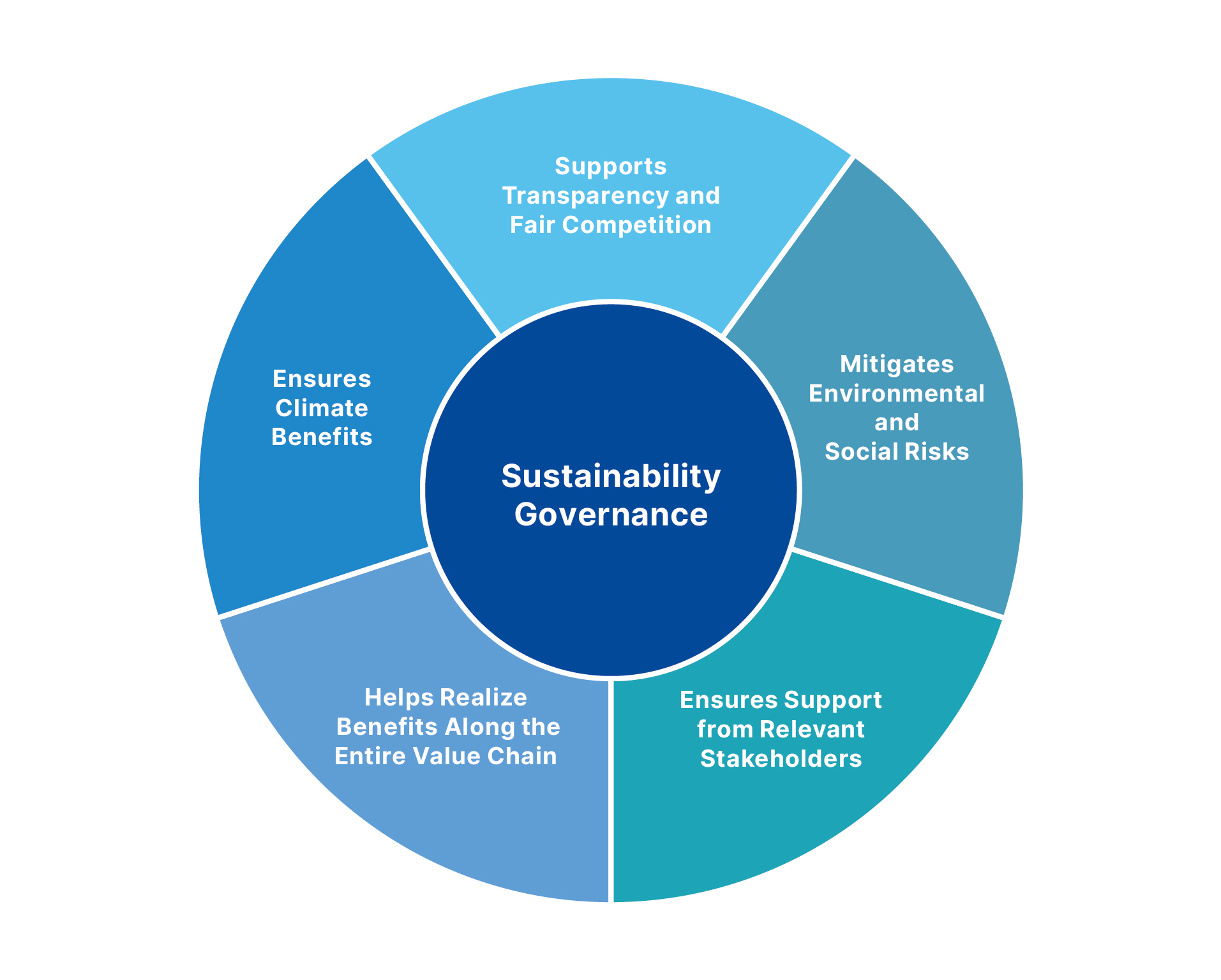
Finally, this policy paper proposes four measures at international and EU level that not only make governance structures more effective in supporting sustainability goals, but also strengthen capacities along the value chain.
1. Recommendation: Develop guidelines for hydrogen to implement sustainability-related due diligence
Guidelines for hydrogen to implement sustainability-related due diligence can help companies gain access to finance whilst strengthening efforts to mitigate environmental and social risks. A joint initiative by the major multilateral development banks and key private financial institutions to develop such guidelines for the hydrogen sector could help establish a global benchmark for this purpose.
2. Recommendation: ISO standard for hydrogen sustainability
In addition to the development of sector-specific guidelines, the introduction of an ISO standard for assessing sustainability in the hydrogen sector could further support the harmonisation and alignment of approaches over time. It also provides certainty for project developers in times of potential regulatory changes. In Germany, a draft sustainability standard for hydrogen has already been developed by the national standards institute DIN, which could be adopted at the international level.
3. Recommendation: Promote best practices in sustainability, capacity building and knowledge sharing
The promotion of best practices in the field of sustainable hydrogen production, combined with capacity building and knowledge sharing, can strengthen the ability of project developers to develop credible and cost-effective approaches to meeting sustainability criteria and due diligence obligations. Stakeholders such as the International PtX Hub are already playing an important role in this regard.
4. Recommendation: Ensuring a level playing field through robust certification systems
Ensure a level playing field for all economic operators by having the European Commission implement the established monitoring and reporting obligations.
Study defining sustainability governance
In their study “Governance for a Sustainable Hydrogen Economy. A Review of the Current State of Play”, published concurrently and forming the basis for this policy paper, the authors examine approaches from various regions in detail. For the first time, the two authors define what sustainability governance entails – a definition that is not limited to the hydrogen economy but can also be applied to other sectors.
Firstly, it encompasses government strategies, rules and regulations designed to ensure sustainability in the hydrogen sector. These include direct requirements for actors in the hydrogen value chain, as well as regulations aimed at creating transparency regarding specific economic activities.
Furthermore, there are sustainability-related rules and framework conditions that apply to the financing of hydrogen-related facilities. This may concern government support programmes as well as financing by public and private financial institutions.
Standards and certification systems serve as the basis for defining and verifying sustainability requirements or claims. These are intended to be core elements of a developing, sustainability-oriented quality infrastructure in the hydrogen sector.
Finally, high-level principles and initiatives serve as reference points for sustainability governance mechanisms and provide guidance to actors along the value chain towards more sustainable practices.
The authors’ conclusion: The European Union’s existing sustainability governance framework provides a basis for the sustainable expansion of the hydrogen sector. To be effective, therefore, there is no need for a multitude of new instruments or mechanisms. Rather, the next step requires targeted adjustments and additions to drive forward the expansion of a sustainable hydrogen sector.

