Chandigarh University Researchers Develop an Economical Device for Accurate Drug Absorption Studies; to Help in Reducing Cost of Medicines by 40%

Chandigarh University researchers get patent for an energy-efficient, economical device for accurate drug absorption studies
CHANDIGARH, India, July 28, 2026 /PRNewswire/ — A team of researchers at Chandigarh University has developed an innovative laboratory device that could significantly improve the way oral medicines are tested during development, enabling more accurate, reliable and cost-effective drug absorption studies that can ultimately support the development of safer and more effective medicines. By addressing several long-standing limitations in conventional drug absorption equipment, the innovation enables researchers to generate more dependable experimental data while reducing the likelihood of failed studies, repeated experiments and unnecessary research costs. The improved version of the apparatus also reduces the size and complexity of the conventional equipment, resulting in a 40 per cent reduction in operational costs and making a low-cost version of the device available for pharmaceutical research and routine laboratory use.
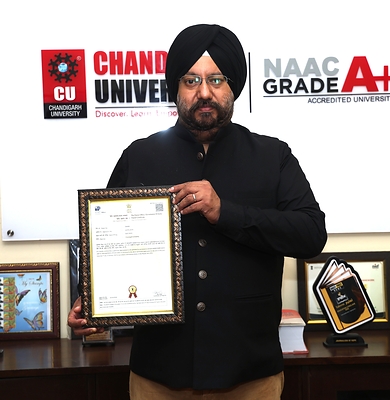
Recognizing the novelty and practical significance of the innovation, the Indian Patent Office has granted the Chandigarh University researchers a patent for their invention titled ‘Improved Oral Drug Absorption Study Cell’. The innovation, developed by Chandigarh University researchers, Prof. (Dr.) S.S. Sehgal and Prof. (Dr.) Manish Goswami (former professor at University Institute of Pharmaceutical Sciences), Chandigarh University, has been granted a patent by the Indian Patent Office for its novel design. The patented device introduces engineering improvements that overcome several limitations of the conventional drug absorption apparatus while remaining simple to manufacture, economical to operate and suitable for routine laboratory use.
The reliable drug absorption studies form the foundation of oral medicine development, helping scientists determine whether a medicine administered orally can efficiently cross the intestinal barrier and enter the bloodstream before it progresses to advanced stages of research. More accurate laboratory data allows researchers to optimise formulations much earlier in the development cycle, reducing uncertainty before medicines move to expensive pre-clinical and clinical evaluation while strengthening confidence in pharmaceutical research.
Sharing details and significance of the innovation, Prof. (Dr.) S.S. Sehgal said, “Drug absorption studies are among the most important stages in oral drug development because they help scientists understand how efficiently a medicine is likely to be absorbed before it progresses to advanced stages of research. The conventional drug absorption equipment offer very limited space, forcing researchers to fold the everted intestinal tissue inside the chamber. This places unnecessary stress on the tissue, affects its natural positioning and can result in variability into the drug experimental observations. In many cases, tissue damage or improper placement can even result in experimental failure that forces researchers to repeat the study and increase both development time and research costs.”
Prof. Sehgal added, “Instead of altering the testing methodology, we redesigned the apparatus to address the limitations of conventional systems. By introducing an extended side arm, our equipment allows the tissue to remain in a natural U-shaped position helping in proper drug absorption to occur under consistent conditions. Along with improved temperature uniformity, better mixing of the drug solution and greater operational stability, the redesigned apparatus helps generate more accurate and reproducible data that can improve the evaluation of oral drug formulations.”
Highlighting the broader impact of the invention, Prof. (Dr.) Manish Goswami said, “Scientific progress is often driven by improving the tools researchers use every day. Even relatively small improvements in laboratory equipment can have a significant impact on the quality of research data. By making drug absorption studies more reliable and easier to perform, this innovation can support pharmaceutical scientists in developing better oral formulations and ultimately contribute to medicines that offer greater therapeutic effectiveness for patients.”
Elaborating on the improvements, Dr. Manish Goswami said, “Our objective was to improve the reliability of the experiment through a simple yet effective engineering solution. One of the biggest advantages of this innovation is that it minimizes variations during sample collection, making drug absorption studies more reliable and consistent. The device features a compact design built using laboratory-grade materials such as borosilicate and Teflon-coated glass to ensure durability and precision. At the same time, its optimized architecture reduces the overall size of the apparatus, simplifies fabrication and handling, and lowers operational costs by 40 per cent, making it an economical solution for pharmaceutical research. These improvements create more consistent and reproducible experimental conditions, enabling researchers to generate higher-quality data without adding complexity to the procedure.”
The innovation is expected to benefit through its application in pharmaceutical industry, drug discovery and development sector, pharmaceutical R&D centres, Contract Research Organizations (CROs), Clinical Research Organizations (CROs), universities and pharmacy colleges, government research laboratories and regulatory testing laboratories where drug absorption studies are routinely carried out for formulation development, pre-clinical research and evaluation of oral medicines.
Apart from improving the experimental accuracy, the redesigned apparatus also reduces operational complexity by eliminating the need for extra heating arrangements. Its simplified design lowers energy requirements, improves laboratory efficiency and reduces overall operating costs, making it suitable for routine use across pharmaceutical laboratories, academic institutions and research organisations.
With oral medicines accounting for the majority of pharmaceutical formulations used worldwide, improvements in early-stage drug absorption studies can strengthen the entire drug development process. By enabling more reliable laboratory testing while reducing time, cost and experimental variability, Chandigarh University’s patented innovation has the potential to support faster formulation optimisation, improve pharmaceutical research and contribute to the development of safer, more effective oral medicines for patients across the globe.
About Chandigarh University
Chandigarh University is a NAAC A+ Grade University and QS World Ranked University. This autonomous educational institution is approved by UGC and is located near Chandigarh in the state of Punjab. It is the youngest university in India and the only private university in Punjab to be honoured with A+ Grade by NAAC (National Assessment and Accreditation Council). CU offers more than 109 UG and PG programs in the field of engineering, management, pharmacy, law, architecture, journalism, animation, hotel management, commerce, and others. It has been awarded as The University with Best Placements by WCRC.
Website address: https://www.cuchd.in/
 View original content to download multimedia:https://www.prnewswire.com/in/news-releases/chandigarh-university-researchers-develop-an-economical-device-for-accurate-drug-absorption-studies-to-help-in-reducing-cost-of-medicines-by-40-302836315.html

