NIT Rourkela, IIT Researchers Develop Lead-Free Smart Materials for Anti-Counterfeiting and Sensors

Rourkela, Oct 28: Researchers from the National Institute of Technology (NIT) Rourkela, in collaboration with scientists from IIT Guwahati, IIT Bombay and the National Institute of Science Education and Research (NISER), Bhubaneswar, have developed innovative lead-free materials that respond to changes in temperature and moisture, opening up potential applications in anti-counterfeiting technology, humidity sensors and advanced lighting systems.
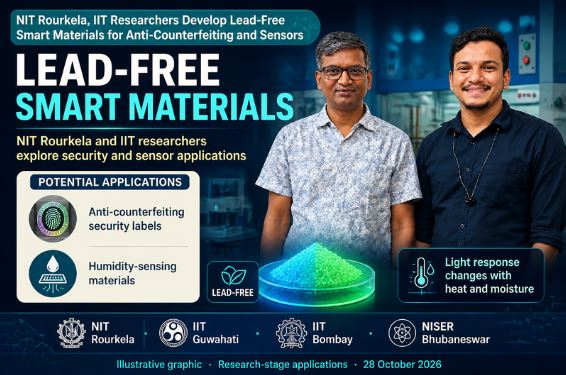
Representational Image
The research focuses on bismuth-based organic-inorganic hybrid compounds that change their light-emitting properties in response to environmental conditions. The findings, published in the Journal of Materials Chemistry C, could offer a safer alternative to conventional lead-based photoluminescent materials, which raise environmental and health concerns because of lead toxicity.
Smart Materials That Change Colour Under UV Light
According to the research team, the material undergoes a reversible transformation when exposed to heat and moisture. When heated, it loses water trapped within its structure and emits blue light under ultraviolet (UV) radiation. Upon exposure to moisture, it absorbs water again, causing the blue-light emission to disappear.
This ability to switch its optical response according to environmental conditions could make the material useful in applications requiring sensitive and reversible detection.
Prof. Saroj L. Samal, Associate Professor in the Department of Chemistry at NIT Rourkela, said the compound was synthesised using relatively inexpensive, environmentally friendly constituents through a simple synthesis process. He highlighted its reversible structural changes and corresponding variations in light emission as key features of the material.
Potential Breakthrough in Anti-Counterfeiting
The researchers believe the material could be used to develop security inks for certificates, signatures, product labels and other items vulnerable to counterfeiting.
Its response to controlled heating and UV light could provide an additional layer of authentication, helping distinguish genuine documents and products from fraudulent copies.
The material may also have applications in humidity sensors for food packaging, storage facilities and other environments where moisture monitoring is important. However, further research will be needed to establish its performance and reliability in practical applications.
New Possibilities for Energy-Efficient Lighting
In a related development, the team has also produced lead-free materials that emit yellow light under UV radiation. By combining this material with a commercially available blue-light-emitting material, the researchers generated white light with a cool, daylight-like appearance.
The resulting system demonstrated stable light emission during continuous operation, suggesting potential applications in light-emitting diodes (LEDs) and light-conversion technologies.
The research involved scientists from NIT Rourkela, IIT Guwahati, IIT Bombay and NISER Bhubaneswar. The paper was co-authored by Prof. Samal and research scholar Subhasish Sahoo, along with Prof. Parameswar K. Iyer and Chakali Srinivas of IIT Guwahati, Rajanikanta Rana of IIT Bombay, and Prof. Himansu S. Biswal and Laxmipriya Dash of NISER Bhubaneswar.
Next Step: Practical Applications
The researchers plan to improve the materials’ light-emission efficiency, long-term stability and sensor sensitivity while exploring their integration into functional devices.
The findings could contribute to future advances in optical security, environmental monitoring and lighting technology. While commercial applications will require further development and testing, the research highlights the potential of lead-free smart materials to address both technological needs and environmental concerns.
