New Delhi, Nov21: Pt. Birju Maharaj Ji’s Kalashram School of Dance and Music, in collaboration with the Indira Gandhi National Centre for the Arts, Bharatiya Sanskriti Darshan Australia, Bharatiya Sanskriti Darshan Trust and ScoreSounds Australia, will present Standing at Eternity, an evocative confluence of poetry, music and dance, on Saturday, November 21, 2026, from 6:30 pm onwards at Samvet Auditorium, Ground Floor, IGNCA, Janpath, New Delhi.
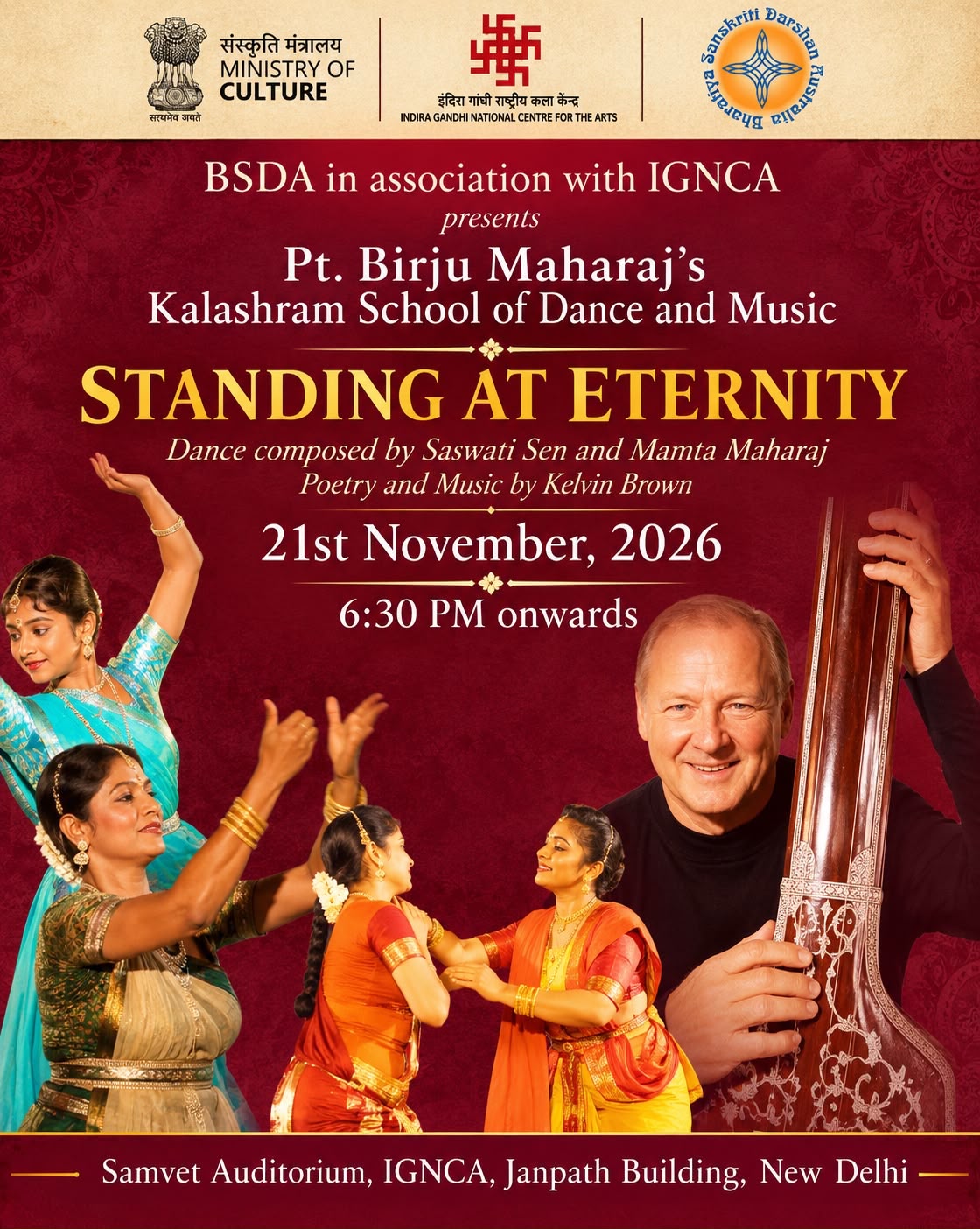
The production will feature the poetry of Australian poet Kelvin Brown, brought to life through dance by students of Kalashram under the guidance of acclaimed Kathak exponent Mrs Saswati Sen and choreographer Mamta Maharaj.
Dr Sachchidanand Joshi, Member Secretary, IGNCA, will grace the occasion as the Chief Guest, while Dr Sushrut Sardeshmukh, Trustee, Bharatiya Sanskriti Darshan Trust, will be the Guest of Honour.
The presentation marks another significant initiative under the Memorandum of Understanding between BSDA and IGNCA, further strengthening cultural ties between India and Australia. Established with the objective of promoting, nurturing and preserving India's traditional cultural heritage among Australian audiences, BSDA is represented by Louise Herft, Kelvin Brown and Heather Brown. ScoreSounds Australia, a music production company, is also an important partner in this collaboration.
Dr Achal Pandya, Head of Conservation, IGNCA, along with Pranab Chakraborty and the IGNCA team, has played an instrumental role in facilitating and strengthening these cultural connections.
Standing at Eternity explores the universality of India's ancient cultural traditions through an artistic dialogue between poetry and dance. Its distinctive feature lies in translating the imagery, emotions and deeper meanings of poetry into physical expression. Through the visual vocabulary of dance, the production enables audiences to experience poetry beyond the limitations of language, bringing literature, music and movement together in a shared artistic experience. It also reflects the timeless relationship between India's cultural traditions and universal human experiences.
The inspiration behind the title, according to Kelvin Brown, emerged from his visit to the Ellora Caves many years ago. The magnificent caves and sculptures, created over generations by skilled stonemasons, offered him a profound insight into eternity, the passage of time and the enduring nature of human creativity. His poem Standing at Eternity, inspired by this experience, forms the central theme of the production. The selection of poems explores the continuing journey of life and experiences that remain etched upon the eternal soul. Brown's association with India also extends to the literary sphere. At the wish of the founder of the Poetry Society of India, the late Dr H.K. Kaul, he was accorded life membership of the Society.
Speaking about the concept, Kelvin Brown said,
“Poetry has the ability to create images and evoke emotions that transcend language. Through dance, these images find another form of expression. The coming together of words, music and movement offers audiences a different way of experiencing poetry and discovering the connections between the arts.”
For Mrs Saswati Sen, the presentation is an exploration of Antar Yatra, or the inner journey. Her artistic interpretation views dance as an experience that transcends the physical body, engaging the mind and soul. Rooted in the philosophy of Chitta-Vritti-Vilasa, dance becomes a celebration of beauty, emotion, rhythm and intention. The coming together of poetry and imagery creates Drishya-Kavya, or visual poetry, through which this inner journey finds expression.
The poems explore a spectrum of eternal emotions and experiences, ranging from undying love reflected through the moon and the sweetness of dreams to celestial messages carried on the wings of birds. The interplay between stillness and movement, represented through the concepts of Sthiti and Gati, forms another important dimension of the presentation. This is reflected in the depiction of Ardhanarishwara, symbolising the union of masculine and feminine energies.
Sharing her vision for the production, Mrs Saswati Sen said,
“Dance is much more than a physical expression. It is an inner churning of beauty, emotion, rhythm and intention. Through this presentation, we seek to bring the imagery and poetry together as a visual experience, taking audiences on an Antar Yatra where the individual, nature and the cosmic become one.”
Dr Sachchidanand Joshi, Member Secretary, IGNCA, observed,
“IGNCA has always sought to create platforms that encourage the understanding and appreciation of India's diverse cultural traditions. Standing at Eternity brings together literature, music and dance in a manner that allows audiences to engage with our cultural heritage through multiple artistic expressions. Such collaborations also strengthen the exchange of ideas and artistic practices between countries.”
Dr Sushrut Sardeshmukh, Trustee, Bharatiya Sanskriti Darshan Trust, said,
“India's cultural traditions have a remarkable ability to transcend time, geography and language. Initiatives such as Standing at Eternity create meaningful opportunities to take these traditions to wider audiences while encouraging artistic dialogue between India and Australia. It is particularly encouraging to see poetry and dance come together to celebrate ideas that are universal and timeless.”
Louise Herft, Bharatiya Sanskriti Darshan Australia, remarked,
“At Bharatiya Sanskriti Darshan Australia, our endeavour has been to nurture and share India's rich cultural heritage with Australian audiences. Standing at Eternity is another meaningful step in this direction. It brings together artists and cultural organisations from both countries and demonstrates how traditional art forms can continue to find new expressions and connect people across cultures.”
Mamta Maharaj, Choreographer, Kalashram School of Dance and Music, said,
“Translating poetry into dance requires an understanding of the emotions, imagery and deeper meanings within the words. This production offers our students an opportunity to explore poetry through movement and expression, while engaging with themes that are deeply rooted in India's artistic and philosophical traditions.”
The programme will open with a Vedic chant, followed by Standing at Eternity, which introduces the central theme of the production. What is Time explores the relationship between time and human existence. The subsequent compositions include Titten Titten Nara, The Heart of Our Dance, Long Ago, Sweet Night of Dreams, Window and A Walking Princess. Together, these compositions explore diverse facets of life, memory, love, dreams and the eternal human spirit.
Through this Indo-Australian collaboration, Standing at Eternity brings together the literary imagination of an Australian poet and the expressive richness of Indian classical dance. The production promises to be a compelling artistic encounter, celebrating the enduring connections between art, culture, tradition and humanity, while reaffirming the potential of cultural collaborations to transcend geographical and linguistic boundaries.