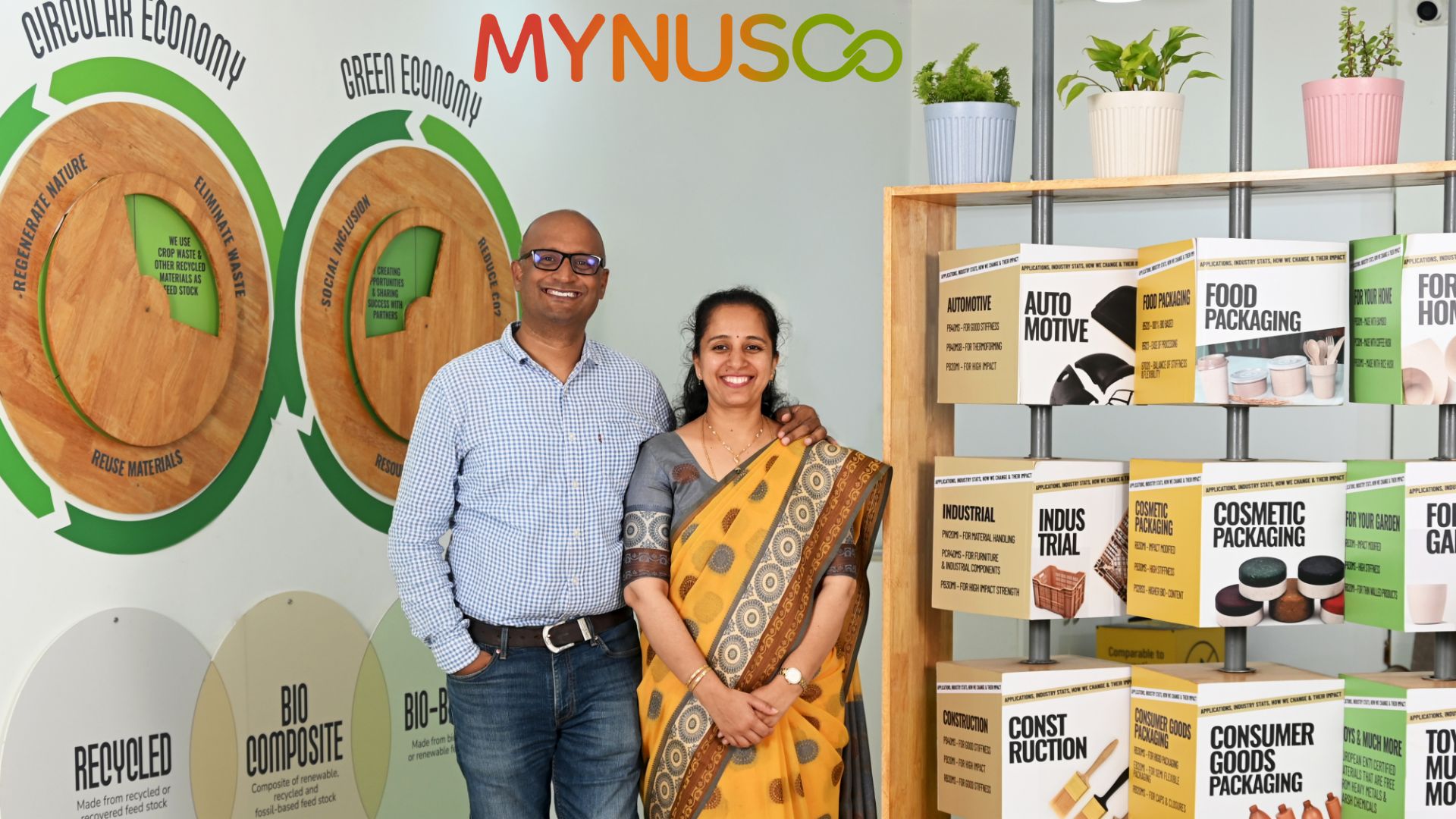
New Delhi, Dec 5:-MYNUSCo, the Bengaluru-based biomaterials enterprise that transforms agricultural waste into high-performance materials, has expanded beyond automotive applications into consumer markets. This post-COVID strategic shift marks a pivotal moment for the company, founded in 2015 by Mahadev Chikkanna and Shruthi Ujjani Ramesh, positioning it to significantly scale its environmental impact.
The company spent its first five years in R&D, developing proprietary biocomposite technologies without external funding. Its breakthrough came in 2019 with a contract from a global automotive OEM to supply biocomposites for car interiors. However, the pandemic prompted a complete strategic rethink.
“COVID-19 disrupted global supply chains and clarified our path we needed materials that touch everyday life, not just automotive interiors,” says Mahadev Chikkanna, Co-Founder of MYNUSCo.
This realization led to eha.eco, a consumer brand offering sustainable lifestyle products such as planters, homeware, and gifting solutions. Recent initiatives include Loopac.eco for circular packaging and 3s.eco for carbon-negative construction solutions. MYNUSCo has transformed from a biomaterials supplier into a one-stop, end-to-end platform for biomaterials and circularity adoption from sourcing crop waste to delivering finished products making it a pioneering enterprise not just in India, but globally.
MYNUSCo’s biocomposites utilize bamboo waste, rice husk, straw, coir, and other agricultural by-products that would otherwise be burned. These materials are categorized as BioDur for durable goods and BioPur for compostable applications. Every material is supported by an ISO-verified Life Cycle Assessment system, providing transparent carbon accounting from source to finished product. To date, MYNUSCo’s work has prevented over 2,000 tons of CO₂ emissions equivalent to removing roughly 1,400 cars from the road for a year.
With 45% of its staff being women, the company operates its biocomposites manufacturing base in Mysuru and partners with molding units across India to convert biomaterials into finished products. This collaboration enables existing manufacturing ecosystems to transition to sustainable materials while scaling impact rapidly.
“Industries and consumers shouldn’t have to choose between sustainability and performance,” explains Mahadev Chikkanna. “We provide a verified path to circularity that fits within existing norms.”
“Sustainability must include social equity,” adds Shruthi Ujjani Ramesh, Co-Founder. “We are committed to creating shared success across our entire value chain, not just for the company and shareholders. What was once seen as a challenge has now become one of our greatest strengths.”
Looking ahead, MYNUSCo plans to expand into new product categories. Its impact has accelerated dramatically carbon reductions that once took a year to achieve now happen in under a month. With stricter sustainability regulations and growing consumer awareness, the company aims to become the preferred partner for brands seeking verified low-carbon alternatives.
From its origins in curiosity about climate change, MYNUSCo has evolved into one of India’s most credible circular economy platforms, demonstrating that sustainability can move from lab experiments to tangible everyday impact.