
New Delhi, September 23, 2026: Union Minister for Heavy Industries and Steel H.D. Kumaraswamy held discussions with a delegation from the European Parliament’s Committee on Industry, Research and Energy (ITRE) in New Delhi, with talks centred on strengthening cooperation between India and the European Union in electric mobility, battery manufacturing, clean energy and industrial decarbonisation.
The meeting brought together Members of the European Parliament and officials from the ITRE Secretariat to discuss opportunities for deeper collaboration in industrial development, technology, investment and sustainable manufacturing.
Kumaraswamy said the visit comes at an important stage in India-EU relations following the 16th India-EU Summit held in January 2026, where FTA negotiations were concluded and the two sides adopted a Joint India-EU Comprehensive Strategic Agenda. He highlighted the scope for expanding cooperation in trade, investment, technology and global supply chains.
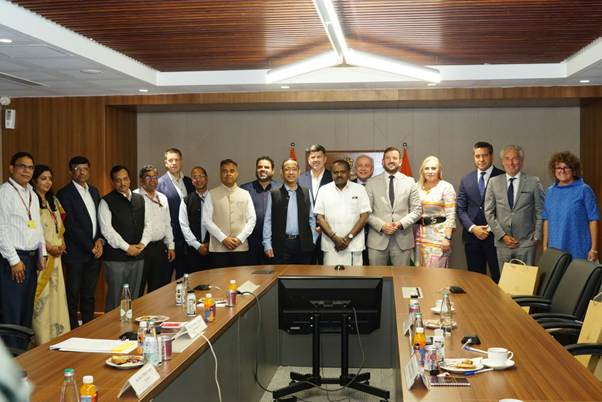
During the discussions, the Minister outlined several initiatives being implemented by the Ministry of Heavy Industries to strengthen India’s manufacturing capabilities and accelerate the transition towards electric mobility.
These include the Production Linked Incentive (PLI) Scheme for Automobiles and Auto Components, the PLI Scheme for Advanced Chemistry Cells (ACC) and the PM E-DRIVE scheme. According to the Ministry, these programmes are designed to support domestic manufacturing, encourage investment and strengthen India’s electric vehicle and battery ecosystem.
Kumaraswamy also invited European companies to participate in India’s ongoing global bidding process for 10 GWh of Advanced Chemistry Cell manufacturing capacity intended for stationary energy storage applications. The bidding process is open until October 13, 2026.
Industrial decarbonisation was another key area of discussion. The Minister highlighted India’s efforts to reduce emissions from industrial sectors while maintaining manufacturing growth. Among the initiatives discussed was BHEL’s indigenous gasification technology, along with measures aimed at improving resource efficiency and supporting cleaner industrial production.
The Minister also outlined India’s approach to greening the steel sector through greater use of scrap recycling, steel slag utilisation and circular economy practices. These measures are aimed at improving resource efficiency while reducing the environmental footprint associated with steel production.
Senior officials from the Ministry of Heavy Industries and Steel, including Secretary Kamran Rizvi and Additional Secretary Hanif Qureshi, participated in the discussions alongside the European Parliament delegation.
Members of the European Parliament delegation acknowledged India’s efforts to expand electric mobility, strengthen domestic manufacturing and advance industrial decarbonisation. They also expressed interest in expanding cooperation in clean technologies, sustainable transportation and advanced energy solutions.
The discussions highlighted areas where India and European industries could potentially collaborate on emerging technologies, manufacturing capabilities and energy-transition solutions. Electric vehicles, battery technologies and industrial decarbonisation are increasingly important areas of cooperation as both sides work towards more sustainable industrial systems.
Kumaraswamy said India and the European Union could combine their respective strengths to support the clean-energy transition and develop sustainable transport solutions. He also emphasised the potential for continued engagement between Indian and European stakeholders in the industrial sector.
The meeting underlined the growing scope of India-EU cooperation beyond traditional trade and investment, with clean technology, advanced manufacturing, electric mobility and sustainable industrial practices emerging as important areas for future collaboration.
