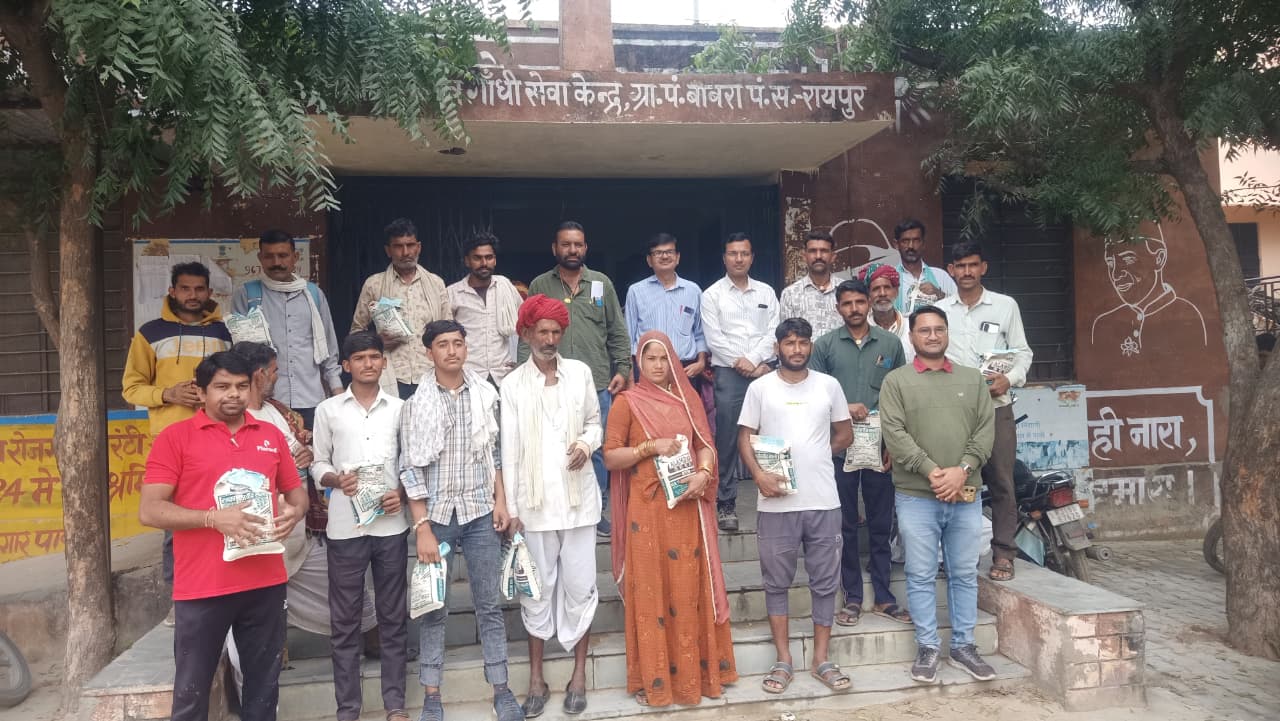
India 14th November,2025:-Shree Foundation Trust, the social development arm of Shree Cement Ltd., one of India’s leading cement producers, distributed Almadar three-year Alfalfa (Rajka) fodder seeds to 1,763 farmers across 13 gram panchayats surrounding its Ras and Beawar units. The initiative aims to enhance fodder availability for livestock and strengthen the income resilience of farming households in the region.
This reinforces the company’s commitment to promoting sustainable agricultural practices and improving rural livelihoods in its operational regions. It forms part of Shree Cement’s broader efforts to drive inclusive development through livelihood enhancement, skill-building, and sustainable resource management.
The seed distribution drive was conducted in the presence of company officials, including Mr. Ashok Kumar Agarwal (Store Head, Ras), Mr. Kushal Sankhla (Electrical Department, Ras), and CSR lead Mr. Vishal Jayswal, Mr. Amit Tak, and executive CSR Mr. Jitendra Kumar Dagdi, along with social workers Mr. Devendra Singh Jodha (Gopalpura–Babra) and Mr. Sohan Lal Kumawat (Bootivas).
Under this programme, a total of 3,526 kilograms of Alfalfa (Rajka) seed was distributed—2 kilograms per farmer. The voluntary contribution amount collected from participants was donated to government schools in the area to support school development initiatives.
Vishal Bhardwaj, CSR Head, Shree Cement, said, “Our community development work focuses on strengthening long-term economic resilience in rural areas. By enabling access to quality agricultural inputs and providing practical crop advisory support, we aim to help farmers adopt productive and sustainable cultivation practices. This initiative reflects our continued commitment to working closely with farming communities and supporting livelihood growth through capacity-building and field-level engagement.”
Beyond seed support, the programme also facilitates knowledge-sharing on agronomic practices, encouraging farmers to adopt diversified cropping systems and sustainable input use. The initiative is designed to enhance crop resilience and contribute to improved income stability for farming households. It is expected to significantly support livestock rearing and promote agricultural sustainability in the region.