New Delhi, 10th December, 2025: The two-day Regional Community Radio Sammelan (East) was inaugurated in Guwahati today. Organised by the Ministry of Information & Broadcasting, Government of India, in collaboration with the Indian Institute of Mass Communication New Delhi, the theme of the Sammelan is “Celebrating 20 Years of Community Radio in India.” More than 65 Community Radio Stations from the Eastern and Northeastern region are participating in the event.
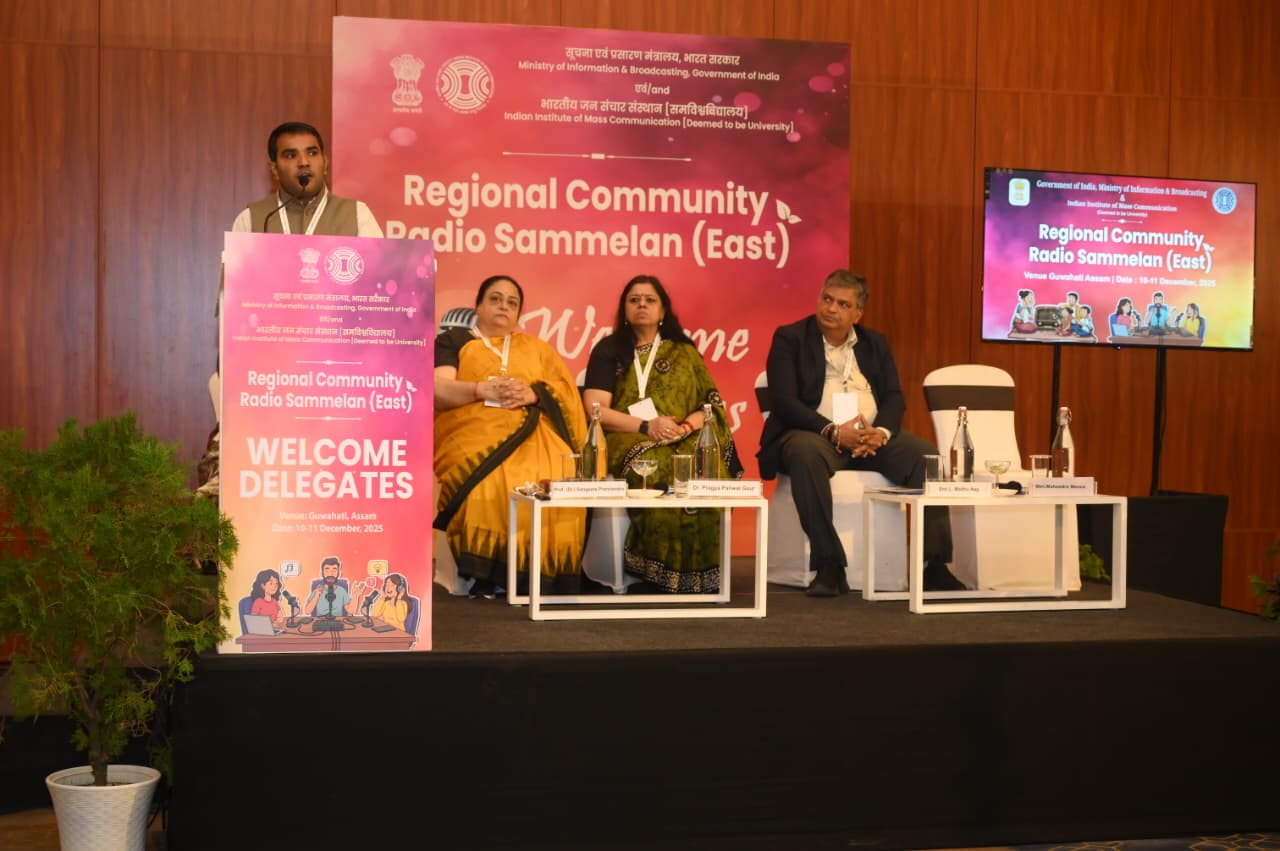
Welcoming the gathering, Dr. Pragya Paliwal Gaur, Vice Chancellor of IIMC, New Delhi said that it was an honour for IIMC to partner with the Ministry for this milestone gathering. She highlighted the growth of the Community Radio ecosystem, with over 550 stations now operating across India and more in the pipeline, including in the Northeast. Dr. Gaur spoke about the important role of Community Radio in promoting gender-sensitive communication, disseminating emergency information, involving students of media education, preserving folk traditions, and responsibly integrating AI in content development. She urged stakeholders to work together to strengthen community-led development through Community Radio.
Delivering his address, Shri L. Madhu Nag, Registrar, IIMC, highlighted the significant transformation of India’s radio landscape from mainstream FM broadcasting to the emergence of Community Radio as a powerful platform for local voices. Emphasizing the core pillars of strengthening CR stations, he underscored the importance of community-driven content creation, enhanced capacity building, and long-term financial sustainability. He noted that creatively produced, locally rooted content remains central to the success of Community Radio.
Ms Shilpa Rao, Director CRS, Ministry of Information and Broadcasting informed about the objectives of the Sammelan and mentioned that the Ministry of Information and Broadcasting is committed to the growth and reinforcement of the Community Radio sector in the North East Region. She also appraised them about the initiatives taken by the Ministry of Information and Broadcasting in this regard.
Shri Mahendra Meena, Under Secretary, Ministry of Information & Broadcasting, remarked that Community Radio stations have become indispensable for last-mile communication. He stated that CR stations amplify real community voices and help ensure accurate information reaches people during emergencies and developmental programmes. He reaffirmed the Ministry’s continued support to the Community Radio movement.
Prof. (Dr.) Sangeeta Pranvendra, Convenor of the Sammelan, extended a warm vote of thanks to all participants for travelling to Guwahati and joining the collective celebration of two decades of India’s Community Radio movement. She appreciated the commitment of CR practitioners and experts who continue to strengthen grassroots broadcasting across the region.
The first day of the sammelan featured several technical and interactive sessions. Deputy Wireless Advisor, Ministry of Telecommunications Shri Manish Sheelwant spoke in detail about transmitter replacement and migration to the SARAL Sanchar portal, along with guidance on applying for WoL renewal.
Prof. (Dr.) Kanchan K. Malik stressed on the relevance of gender based programming and the vital role of women in CRS programming and participation in the overall content management and broadcasting.
A panel discussion on the engagement of State Governments in promoting Community Radio across the eastern region, moderated by Shri Amit Dwivedi, Project Director CRS engaged with CRS practitioners from Bihar, Manipur, Assam, West Bengal and Odisha.
The first day also included an insightful session on ‘Promotion and Preservation of Indigenous Languages and CRS’ led by Prof. Uma Pappuswamy from the Central Institute of Indian Languages, Mysuru. She said that as the nature of the CRS is hyperlocal, indigenous languages can best be preserved and promoted through the CRS.
The day concluded with a session on community-based content, delivered by Shri N. A. Shah Ansari, Director, Radio Namaskar, Konark, Odisha. He spoke on the best practices to be adopted while creating community based content.
The Sammelan provides Community Radio practitioners a platform to share experiences, raise concerns, explore innovative approaches and collectively strengthen the future of grassroots broadcasting across the eastern and northeastern region.