Blog

  • Dr Raghu Ram achieves third Guinness World Records title in 15 months

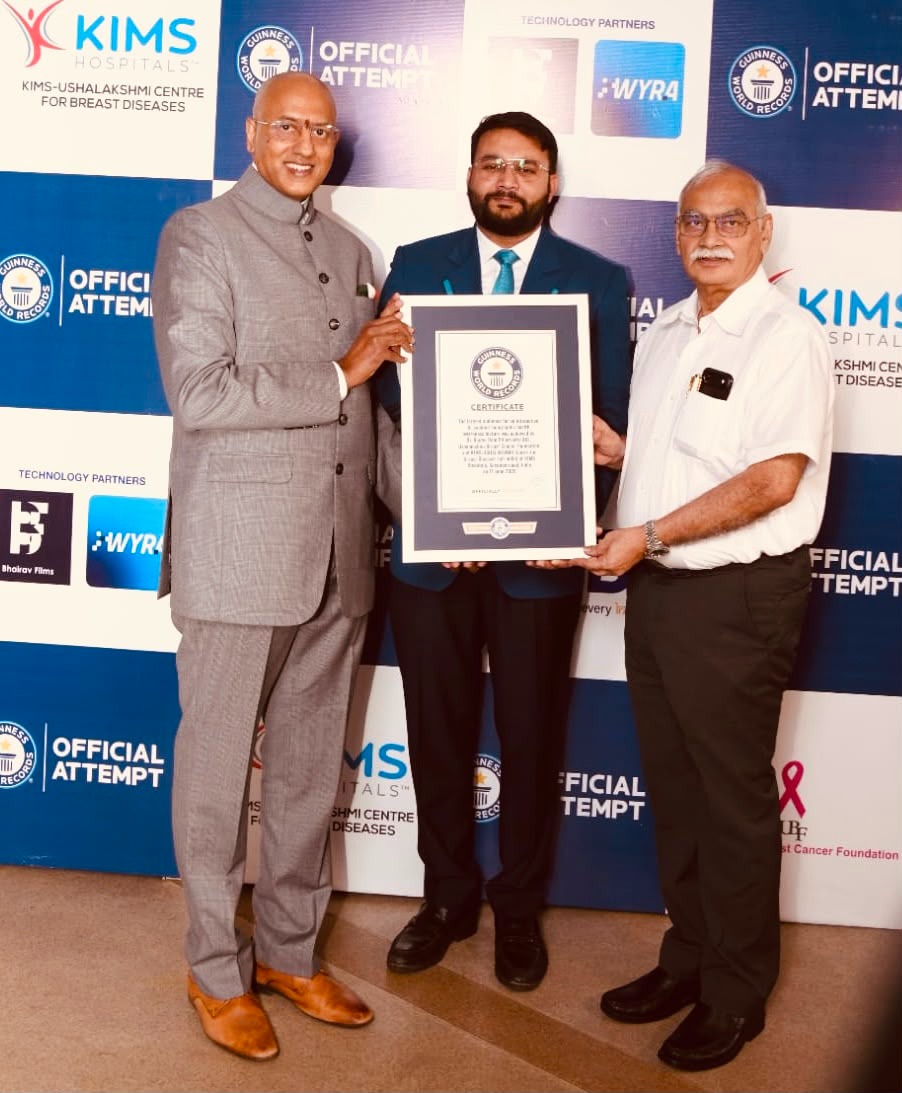
    Hyderabad, June 12 : In a landmark convergence of healthcare, artificial intelligence and immersive technology, Dr P. Raghu Ram, the Ushalakshmi Breast Cancer Foundation and the KIMS-USHALAKSHMI Centre for Breast Diseases jointly secured a Guinness World Records title for hosting the “Largest Audience at an Interactive AI-Enabled Holographic Health Awareness Lecture”. The achievement marks Dr Raghu Ram’s third Guinness World Records title in 15 months, and underscores his continuing commitment to advancing public health education through innovation.

    Dr Raghu Ram achieves third Guinness World Records title in 15 months

    The event featured the AI-generated holographic educator of Dr P. Raghu Ram, delivering a 30-minute breast health awareness lecture followed by a 30-minute multilingual interactive question-and-answer session. The AI-enabled holographic educator provided evidence-based information on both benign breast conditions and breast cancer and responded to audience questions in English, Hindi Telugu and Tamil.

    The Guinness World Records title was awarded under a newly created category recognising innovation in AI-enabled holographic health education. Designed to improve breast health literacy, reduce fear and stigma, encourage timely medical consultation and make reliable health information more accessible, the initiative demonstrated the transformative potential of artificial intelligence and immersive communication technologies in advancing public health awareness.

    The occasion also marked the launch of NARI . An AI-enabled digital breast health educator of Dr Raghu Ram has been designed and programmed to provide round-the-clock access through a dedicated link to reliable, evidence-based information in multiple languages on breast health, breast cancer, breast screening and early detection. Developed with robust clinical and ethical guardrails, NARI has been created to ensure safe, responsible and compassionate educational interactions while expanding access to credible breast health information across urban and rural communities alike. The platform enables users to ask questions and receive educational guidance in multiple Indian languages, helping bridge important gaps in breast health awareness and access to information.

    The event was graced by Dr Abhijat Sheth, Chairman, National Medical Commission, as Chief Guest. Addressing the gathering he said

     “I congratulate Dr Raghu Ram on this remarkable Guinness World Records achievement. What is particularly noteworthy is that this is not merely a record, but a public health innovation with the potential to benefit countless individuals. I understand that this is the third Guinness World Records title secured by Dr Raghu Ram within a span of just 15 months. That is an extraordinary achievement by any standard, with each achievement being driven by a larger purpose—to advance healthcare education, awareness and public engagement. The launch of NARI represents an important step towards making reliable breast health information accessible to people across India through the responsible use of technology and artificial intelligence. Initiatives such as these have the potential to significantly strengthen health literacy and empower individuals to make informed healthcare decisions.”

    Highlighting salient aspects about today’s initiative, Dr P. Raghu Ram, Founder & Chairman, Ushalakshmi Breast Cancer Foundation and Founding Director, KIMS-USHALAKSHMI Centre for Breast Diseases said

    “I dedicate this recognition to my late mother, Dr Ushalakshmi, a distinguished gynaecologist and breast cancer ‘conqueror’ whose strength, compassion and dedication to women’s health inspired the creation of the Ushalakshmi Breast Cancer Foundation. Her journey taught us that awareness, early detection and hope can save lives. This recognition is a tribute to her enduring legacy and to every woman whose life has been touched by breast cancer. Our objective is simple – to democratise access to credible breast health information, reduce fear and stigma, encourage early detection and empower women through knowledge and awareness. The Guinness World Records achievement is not an end in itself. Rather, it serves as a platform to draw attention to an important public health message and to the potential of technology in making reliable health information accessible to people regardless of geography, language or socioeconomic background.”

    Expressing his profound happiness about this remarkable achievement,  Dr Bhaskar Rao Chairman, KIMS group of Hospitals said

    “Our Institute is proud to support pioneering initiatives that combine innovation, technology and healthcare for meaningful social impact. For nearly two decades,    Dr Raghu Ram has championed several transformative breast health awareness initiatives aimed at improving early detection and public education in India. This latest endeavour demonstrates how artificial intelligence can be leveraged responsibly to improve health education and public engagement at scale. When Raghu Ram undertakes something, he does it with complete commitment and dedication, and this achievement is yet another example that visibly demonstrates his passion for using innovation to improve people’s lives.”

    Synopsis of Statements from other distinguished Guests

    Distinguished attendees included Mr K. Padmanabhaiah, Chairman, Court of Governors, Administrative Staff College of India; Dr Ananda Shankar Jayant, renowned classical dancer, Padma Shri awardee and breast cancer conqueror; Dr C. Mallikarjuna, Vice President, National Board of Examinations in Medical Sciences; along with several healthcare leaders, public figures and social media influencers commended Dr Raghu Ram for innovatively utilising artificial intelligence and holographic communication to advance breast health awareness in India.

  • Disha Publication Launches Errorless 202 PYQ Series With Self-Grading Revision System for JEE 2027


    Disha Publication Launches Errorless 202 PYQ Series With Self-Grading Revision System for JEE 2027


    New Delhi, June 12:Disha Publication , a leading name in India’s educational publishing space, has launched the Errorless 202 New Syllabus Chapter-wise & Topic-wise 25 Years JEE Main PYQ Series (2026–2002) for JEE 2027 aspirants to help students move beyond conventional question-solving and adopt a more structured preparation approach.

    As competition intensifies and preparation strategies become increasingly data-driven, Previous Year Questions (PYQs) continue to play a central role in helping students understand exam patterns and question trends. However, most PYQ resources stop at practice. The Errorless 202 Series seeks to go a step further by integrating practice, revision, and testing within a single framework, enabling students to use PYQs as a more structured preparation tool.

    Commenting on the launch, Avinash Agarwal, Director, Disha Publication, said, “For more than two decades, we have observed how students prepare for competitive examinations and how their preparation evolves as the exam approaches. While PYQs remain one of the most effective preparation resources, many students use them only for practice. They often lack a structured way to revisit mistakes, identify weak areas, and measure progress over time. The Errorless 202 Series was created to address this gap by bringing together practice, revision, and testing within a single framework, helping students prepare in a more organised and purposeful manner.

    The series follows a three-step Practice-Revision-Testing (PRT) framework. Students can work through 25 years of JEE Main questions arranged chapter-wise and topic-wise, supported by detailed solutions and separate sections for MCQs and Numerical Value Questions. A key differentiator is the Self-Grading Sticker System, which allows students to mark questions that require revision or those they find particularly challenging, creating a personalised revision repository as preparation progresses.

    The series also includes three-level mini quizzes for self-assessment, NCERT Page Locators for quick concept revision, and last five years’ trend analysis to help students identify important topics. Aligned with the latest JEE syllabus, the series is designed to support students throughout their preparation journey rather than only during the practice phase.

    The Errorless 202 New Syllabus Chapter-wise & Topic-wise 25 Years JEE Main PYQ Series is available on Amazon and Flipkart. Students can also purchase the series through the official Disha Publications website, where launch offers are available, including complimentary Physics Flashcards featuring 55 high-impact revision cards for Classes 11 and 12, designed around active recall techniques.


  • Odisha STF SP Swathy S. Kumar Appointed Joint Deputy Director in Intelligence Bureau

    Bhubaneswar, June 12 (UDN): In a significant development for Odisha Police, senior IPS officer and Superintendent of Police (SP) of the Special Task Force (STF), Swathy S. Kumar, has been approved for Central deputation and is set to join the Intelligence Bureau (IB), one of India’s premier intelligence agencies.

    News In Pics

     Swathy S Kumar Photograph:(Screenshot grab pic)

    According to official sources, the 2017-batch Odisha cadre IPS officer has been selected for appointment as Joint Deputy Director in the Intelligence Bureau. The Odisha Director General of Police (DGP) has granted the necessary clearance for her deputation, enabling her transition to the new national-level assignment.

    Currently serving as the SP of the STF, Swathy Kumar has been at the forefront of several high-profile operations involving organized crime, narcotics trafficking, cybercrime, wildlife offences and other sensitive investigations. She was entrusted with the responsibility of leading the elite anti-crime unit by the Odisha Home Department on May 24, in recognition of her professional competence and leadership abilities.

    Her selection for a key role in the Intelligence Bureau is being viewed as a testament to her distinguished service record and expertise in intelligence-led policing. In her new role as Joint Deputy Director, she will be involved in critical intelligence gathering, national security coordination and strategic operations related to internal security.

    Officials believe that the deputation of an Odisha cadre officer to such an important position in the Intelligence Bureau will further strengthen institutional coordination between state and central security agencies.

    The formal process of her joining the Intelligence Bureau is expected to be completed after the required administrative procedures are finalized. Her appointment is regarded as a matter of pride for Odisha Police and reflects the growing contribution of the state’s officers to India’s security and intelligence framework.

  • Airrived Named Gartner Tech Innovator for the Second Time, Recognized in AI Agent Management Platforms

    Gartner spotlights Airrived’s Agentic OS as critical infrastructure for enterprises deploying, scaling and managing custom AI agents


    DUBLIN, Calif.- Airrived, the company behind the Agentic OS, today announced it has been named a Gartner Tech Innovator in the “Emerging Tech: Tech Innovators in AI Agent Management Platforms” report (May 27, 2026). This marks Airrived’s second Gartner Tech Innovator recognition, following its prior inclusion in the “Emerging Tech: Tech Innovators in Agentic AI report (September 16, 2025).

    Airrived was recognized for its Agentic OS, which enables enterprises to deploy, scale, and manage custom AI agents—positioning the company as a leader in domain-specialized agentic AI for enterprise security, IT, and business operations.

    According to the report, “Airrived’s primary innovation is unique in impact and feasibility, as it serves as a comprehensive ‘Agentic Operating System’ that allows organizations to either use prebuilt agentic applications or create their own. The platform is structured across three foundational layers: an ‘Apps’ layer for ready-to-use solutions, an ‘Agents’ layer functioning as modular ‘Lego blocks’ to connect AI with enterprise data, and an ‘AI Tools’ layer to build custom agents from scratch. Its enabling technology relies on a diverse mix of agents, including reinforcement learning with human feedback (RLHF) agents, classical ML clustering agents, and deep reasoning agent meshes to process and analyze data. Airrived differentiates itself heavily through its strict cybersecurity pedigree, advanced data sovereignty, and customer intellectual property (IP) guarantees.”

    “Our vision is simple: democratize AI so that every business user can become an AI expert,” said Anurag Gurtu, Co-Founder and CEO of Airrived. “Historically, building AI applications required data scientists, machine learning engineers, and significant technical expertise. We believe that should no longer be a requirement, and that shift is what Gartner recognized with our Tech Innovator designation in AI Agent Management Platforms.”

    A Different Kind of Foundation

    While much of the market remains fixated on copilots, wrappers, and orchestration layers dressed up as intelligence, Airrived is building something categorically different: the Agentic OS — a new foundational layer for the enterprise that doesn’t just assist, but executes, adapts, governs, and scales.

    The Agentic OS combines fine-tuned domain models, deep reasoning, multi-agent orchestration, and policy-driven control into a single governed infrastructure. It transforms autonomous AI from experimental capability into trusted, production-grade operation. Others are enabling AI to act. Airrived is defining how AI can be trusted to act.

    At the center of this vision is AetherClaw — Airrived’s flagship security capability and the clearest expression of its mission: autonomous systems that operate across every domain of the enterprise, governed by design, and trusted by default.

    Already in Production

    Months after emerging from stealth in February 2026, Airrived is not a promise — it is a platform. The company is already deployed in production at some of the world’s most demanding enterprises:

    • Airrived and Wisdom Technology launched Qatar sovereign cloud with Agentic AI, powering secure, intelligent operations for energy, government, and financial institutions.
    • A Fortune 150 insurance company, running high-volume, mission-critical agentic workflows at enterprise scale.
    • A global bank, with governed autonomous agents operating across regulated financial environments.
    • One of the largest fast-casual restaurant chains in the world, deploying operational intelligence at scale.
    • A major telecom infrastructure provider, running autonomous operations across complex, high-availability infrastructure.

    These deployments are not pilots. They are proof that governed, reliable, scalable agentic intelligence is not a future capability — it is a present one.

    Industry Recognition

    Since emerging from stealth, Airrived has earned major recognition: 2x Gartner Tech Innovator in Agentic AI • Inc. Best Workplaces • Globee Pioneers Award “Best of Category” in AI-Powered App Development Disruptors • Cybersecurity Excellence Award, Agentic AI Platform (highest votes) • Global InfoSec Award, Most Advanced in Agentic AI • Security Today CyberSecured Award • BIG Innovator in Agentic AI • 2026 AI Excellence Award, Business Intelligence Group.

    These honors are not accolades collected at a distance. They are independent validation that Airrived is delivering what the industry has long demanded: agentic AI that enterprises can actually trust.

    What Comes Next

    Gartner’s report makes clear that the urgent imperative for enterprises is to move beyond single-task AI toward multi-agent systems capable of orchestrating complex, cross-domain workflows at scale. The question is no longer whether agentic AI will transform the enterprise. The question is who will build the infrastructure that makes it safe to do so.

    Airrived has answered that question.


  • Serving AI Solutions on Tap: LaunchLemonade Prepares AI Marketplace Launch

    Serving AI Solutions on Tap: LaunchLemonade Prepares AI Marketplace Launch

    LaunchLemonade, the no-code AI platform enabling creators to build and monetise AI agents, has begun beta-testing their marketplace feature, allowing users to buy and sell ready-to-go agentic AI workflows.

    LaunchLemonade is continuing to develop its platform in its mission to democratise access to advanced AI tools. With the introduction of the LaunchLemonade store, the platform is aiming to solidify its capabilities in allowing users to buy, sell and deploy ready-to-use intelligent AI solutions, transforming how individuals and businesses access automation and intelligent digital services.

    Following a successful oversubscribed pre-seed investment round and a $300,000 grant from Google, LaunchLemonade is accelerating development of its platform, with the marketplace positioned as a core component of its long-term vision. The company plans to roll out an initial version of the marketplace by late summer, with in-house products being made available to buy. Broader capabilities are expected later in the autumn, where users can publish their own agents for sale. This phased rollout will enable iterative improvements based on user feedback while expanding the platform’s capabilities at pace.

    Founded in 2024, LaunchLemonade was created by CEO and Founder, Cien Solon, to simplify the process of building, deploying and monetising intelligent AI solutions that automate workflows, generate content and make smarter decisions. Unifying over 300 AI models, LaunchLemonade’s interface formulates specialised agents that complete tasks from content creation to report analysis and research. These agents can be trained from users’ unique data, allowing for highly personalised and context-aware outputs without requiring technical expertise.

    With the introduction of the LaunchLemonade store, users will gain access to ready-to-go agentic AI workflows designed for a wide range of use cases, from marketing and operations to finance and research. Each agent listing includes descriptions, capabilities, pricing and user reviews, offering a consumer-friendly experience while delivering significantly more powerful, outcome-driven functionality. Rather than simply installing software, users will be able to deploy goal-orientated AI agents that can actively complete tasks and integrate into existing workflows. 

    The marketplace will also create new opportunities for developers and creators to monetise their work. By publishing their AI agents on the platform, developers can generate revenue through subscription or usage-based models, while benefiting from LaunchLemonade’s infrastructure, distribution and user base. For businesses and end users, the marketplace removes the need to build AI solutions from scratch, significantly lowering the barrier to adopting automation and enabling faster, more cost-effective implementation. 

    As the wider platform evolves, LaunchLemonade plans to introduce deeper interoperability between agents, allowing users to chain multiple workflows together into more complex automated systems. This vision positions the marketplace not just as a distribution channel, but as an ecosystem of intelligent, collaborative AI agents capable of handling end-to-end processes.

    CEO and Founder Cien Solon said: “The launch of our AI marketplace represents a major milestone in making advanced AI even more accessible and usable for everyone. We’re proud to be building an ecosystem where innovation can scale rapidly and where even smaller businesses can access powerful AI capabilities without technical barriers.”

    With its initial marketplace launch set for late summer and further capabilities planned later in the autumn, LaunchLemonade is positioning itself at the forefront of the emerging AI agent economy, aiming to redefine how AI solutions are built, shared and deployed at scale. 

    Cien concludes by saying: “Big players have dominated the AI economy, which has incidentally held back innovative AI applications from smaller businesses. With our marketplace, we are democratising the AI economy for smaller players, diversifying the talent and solutions on offer, championing those who are solving unique challenges, breaking innovation bottlenecks, and closing the AI literacy gap in businesses.”

    To learn more about LaunchLemonade, visit their website on https://launchlemonade.app/

  • Center for Vein Restoration fellowship program graduates seven physicians, expanding the next generation of venous and lymphatic medicine specialists

    GREENBELT, Md. — Center for Vein Restoration (CVR) announced the graduation of seven physicians from its accredited Venous & Lymphatic Medicine Fellowship Program for the 2025–2026 academic year, marking another milestone in the organization’s effort to expand access to specialized vein care across the United States.

    The graduating fellows are:

    • Dr. Rohit Martha
    • Dr. Rami Ali
    • Dr. Caroly Guillen Aguirre
    • Dr. Madeleine Pfleger
    • Dr. Mohamed Riazuddin
    • Dr. Darius Rutazaana
    • Dr. Sun Yoo

    “The need for highly trained venous and lymphatic medicine specialists continues to grow, and our fellowship program plays an important role in developing the next generation of leaders in the field,” said Dr. Peter J. Pappas, the program director of CVR’s Venous and Lymphatic Medicine Fellowship. “We are proud of this year’s graduating class and the commitment they have shown to advancing patient care.”

    CVR’s 12-month fellowship provides advanced clinical and procedural training in the diagnosis and treatment of chronic venous and lymphatic disorders. Accredited by the American Board of Venous and Lymphatic Medicine (ABVLM), the program equips board-certified physicians from a variety of medical specialties with the expertise needed to address a growing patient population affected by vein disease.

    Since welcoming its first fellow in 2017, CVR has steadily expanded the program in response to increasing demand for specialized vein treatment. What began as a single-fellow program has grown to nine fellowship positions, with an additional eight physicians scheduled to begin training in July 2026. 

    Throughout the fellowship, physicians complete intensive rotations focused on venous ultrasound, ultrasound-guided sclerotherapy, endovenous ablation procedures, ambulatory phlebectomy and other advanced treatment techniques. Fellows gain extensive hands-on experience while working alongside experienced vein specialists in clinical settings across the country.

    The newly graduated physicians join a growing network of fellowship alumni who are helping increase patient access to specialized venous and lymphatic care at CVR and nationwide.

    Applications are currently being accepted for future fellowship classes.

    For more information about the Center for Vein Restoration Fellowship Program, visit centerforvein.com.

  • ECLAT Health Achieves HITRUST r2 Certification, Demonstrating Commitment to Cybersecurity and Information Protection

    HITRUST Certification validates ECLAT’s evaire platform and healthcare performance solutions are meeting rigorous cybersecurity and data protection standards through independent assessment and assurance

    Herndon, Va. (June 11, 2026) — ECLAT Health Solutions, a leading risk adjustment and coding technology partner for Medicare, Medicaid and ACA plans, today announced its AI-powered evaire risk adjustment platform and healthcare performance solutions have earned certified status from HITRUST for cybersecurity and information protection.

    The HITRUST r2 Certification demonstrates that ECLAT has met the requirements defined by a leading cybersecurity assurance leader, confirming that strong controls are in place to protect sensitive data and manage risk effectively.

    Built on the HITRUST Assurance Program, this achievement reflects independent third-party testing, centralized quality assurance, and certification backed by HITRUST’s Cyber Threat-Adaptive engine. These elements ensure continuous alignment with the latest threat intelligence and evolving standards across NIST, ISO, and OWASP.

    “As cybersecurity expectations rise, our stakeholders expect credible, validated assurance,” said Gabe Stein, CEO at ECLAT. “Achieving HITRUST Certification reinforces our ongoing commitment to protecting data, managing risk, and maintaining the trust of those we serve.”

    “The HITRUST Assurance Program is rigorous and reliable because of the comprehensiveness of control requirements, depth of review, and consistency of oversight,” said Bimal Sheth, EVP, Standards Development & Assurance Operations at HITRUST. “HITRUST Certification demonstrates ECLAT is taking the most proactive approach to cybersecurity, data protection, and risk management.”

  • Odisha Govt Pulls Up Colleges Over Low Usage of Free Wi-Fi, Orders Immediate Corrective Measures

    Bhubaneswar, June 11 (UDN): Concerned over the underutilisation of free Wi-Fi services in higher educational institutions, the Odisha Government has directed colleges and universities across the state to take immediate measures to increase student engagement with the facility.

    The Higher Education Department observed that despite the availability of free internet access in campuses, daily data consumption by students remains significantly below expectations in several institutions. The government has expressed concern that the low usage is preventing students from fully benefiting from digital learning resources and online academic opportunities.

    Odisha Govt Pushes Colleges to Boost Use of Free Wi-Fi Facilities

    Representational image

    As part of its digital education initiative, the state government had established free Wi-Fi infrastructure in 130 higher educational institutions to bridge the digital divide and provide students with seamless access to e-learning platforms, research materials, online journals and educational content.

    In a recent communication, the department instructed college authorities to identify the factors responsible for the poor utilisation of the service and implement corrective measures without delay. Institutions have been asked to create greater awareness among students regarding the availability and benefits of the facility.

    The Directorate of Higher Education (DHE) has recommended organising orientation programmes for both new and existing students, along with campus-wide awareness campaigns. Colleges have also been directed to prominently display Wi-Fi login details, registration procedures and usage guidelines at strategic locations such as libraries, laboratories, classrooms and student common areas.

    To encourage meaningful use of the internet facility, faculty members have been advised to integrate digital learning tools into classroom teaching. Students should be encouraged to access online journals, e-books, open educational resources and Massive Open Online Courses (MOOCs) to enhance their academic learning and research capabilities.

    Officials said improving the utilisation of free Wi-Fi services is crucial to achieving the government’s vision of creating digitally empowered campuses and ensuring that public investments in educational technology deliver maximum benefits to students.

  • HIMSHIKHAR 2026 an IIT Mandi and NSDC collaboration setting new NEP standard

    June 11, Mandi: HIMSHIKHAR 2026 a residential summer programme conducted by the Centre for Continuing Education (CCE), IIT Mandi, in collaboration with the National Skill Development Corporation (NSDC).

    The programme brings together students from across the country for two intensive months, students are learning directly from IIT Mandi faculty, researchers, and industry mentors, gaining deep exposure to emerging fields such as Software Development with AI, Data Science, AI & ML, Agentic AI Systems and Entrepreneurship & Venture Building. An intensive, application-focused learning experience, complemented by student leadership initiatives, governance activities, cultural engagement, and sports.

    Bringing together over 600 students from 8 states and 20 cities, the programme provides participants with an opportunity to experience campus life while engaging in academic, cultural and leadership initiatives.

    As part of the programme, four student councils have been constituted across Science & Technology and Entrepreneurship, Sports, Culture and Creative Arts, enabling students to take on leadership responsibilities and contribute to campus life.

    To encourage collaborative learning and student-led governance, participants have been grouped into four houses — Aravalli, Nilgiri, Vindhyachal and Shivalik.

    Students undergo a structured academic journey through faculty-led sessions, projects, workshops, and assessments, ensuring a rigorous and guided learning experience while also participating in activities including jamming sessions, treasure hunts, Minesweeper challenges and tug of war competitions, helping them interact, collaborate and build connections with peers from diverse backgrounds.

    “A meaningful residential programme is not limited to what happens inside a classroom. Through HIMSHIKHAR, participants engage with academic learning while also experiencing collaboration, leadership and community living. The various student-led initiatives, from councils to cultural and sporting activities, are intended to create an environment where students learn from both structured instruction and shared experiences,” said Prof. Tushar Jain, Head, Centre for Continuing Education (CCE), IIT Mandi.

    In response to the success of HIMSHIKHAR 2026, IIT Mandi has launched HIMSHIKHAR Special Edition for those who missed out the first.


  • AI-Powered Railway Control System for Efficient Urban Train Operation

    Researchers develop a new reinforcement learning framework for precise, real-time, and sustainable automatic railway control

    AI-Powered Railway Control System for Efficient Urban Train Operation

    Urban railways play a key role in sustainable transportation systems. However, achieving precise and energy-efficient train control under diverse operating conditions of urban railways remains a challenge. Researchers from Japan have now developed a recurrent reinforcement learning framework for urban railway speed control that combines expert-guided learning and safety filtering. The proposed method demonstrated stable, real-time operation and energy-saving performance, highlighting its potential for next-generation automatic train operation systems.

    As cities continue to expand,railways are expected to become an important component of urban mobility systems. Compared to automobiles and air transport, railways are highly energy efficient and produce relatively low environmental impacts and therefore form an important component of sustainable transportation systems. Thus, researchers have been exploring advanced train control technologies for further improvement of operational efficiency, passenger comfort, and punctuality while reducing energy consumption.

    In this context, Professor Masafumi Miyatake from the Department of Engineering and Applied Sciences in collaboration with doctoral studentMingyu Lyu from Graduate School of Science and Technology, Sophia University,investigated a new AI-based framework for urban railway speed control. The findings were published in Volume 14 of IEEE Access on March 25, 2026.

    Reinforcement learning is a branch of artificial intelligence (AI) which has attracted attention as a promising approach for automatic train operations as it enables an AI agent to learn optimal control strategies by interacting repeatedly with an environment and improving its behavior through trial and error. However, implementing this in railway operation presents several practical challenges including incomplete information about operating conditions, train inertia, braking delays, and strict safety requirements.

    To overcome this, researchers developed a recurrent reinforcement learning framework based on Recurrent Soft Actor–Critic (RSAC) algorithm. RSAC is an AI method that enables train control systems to learn from past driving patterns and adapt to changing railway conditions over time.

    “Our reinforcement learning-based algorithm was capable of adapting train driving control to a wide range of track and rolling stock conditions,” explains Prof. Miyatake.

    Unlike conventional reinforcement learning methods,the proposed approach used arecurrent neural network that can retain information from previous train states. This allowed the system to capture time-based relationships associated with train operation, such as traction response delays, braking history, and inertial effects, thereby improving decision-making under partially observable conditions.The team also used a training approach that allowed the AI system to first learn from examples of expert driving behavior before learning on its own. By studying these optimized driving patterns early in training, the AI was able to learn faster, make better decisions, and develop more stable and efficient train control behavior.

    Apart from this, the team also integrated a safety filter into the framework. The safety filter would override potentially unsafe control commands generated by the AI policy and ensure compliance with the operational constraints such as speed limits and braking feasibility. This mechanism also helped ensure safe operation when the learned policy encountered unfamiliar situations.

    The proposed framework was evaluated through various simulations of urban railway operations over approximately two-kilometer sections between stations. The simulation environment was designed to closely resemble real-world railway conditions, including uphill and downhill tracks, changing speed limits, and required train arrival times.

    Additionally, the proposed AI framework was also compared with several other widely used reinforcement learning algorithms. These included Deep Deterministic Policy Gradient (DDPG), Proximal Policy Optimization (PPO), Twin Delayed Deep Deterministic Policy Gradient (TD3), and Soft Actor–Critic (SAC), which are commonly used to train autonomous decision-making systems.

    Among all the methods tested, our developed frameworklearned faster and performed better than all tested methods,” explains Prof. Miyatake.

    The research also demonstrated strong energy efficiency. While dynamic programming achieved the theoretical minimum energy consumption under ideal conditions, the developed system attained comparable performance while remaining suitable for real-time operation. Meanwhile, conventional reinforcement learning approaches exhibited less stable behavior and higher energy consumption.

    The findings suggest that this framework could help introduce a cleaner and more convenient public transportation by facilitating accurate and energy-efficient train operation at relatively low cost. The study refines the advantages of railways as an energy-efficient and environmentally friendly transportation system contributing towards a sustainable future. Looking ahead, the study may contribute to enhancing the role of railways as a sustainable transportation system—supporting climate change mitigation and sustainable urban development.

    The findings also highlight the potential of AI-driven railway systems to support safer, greener, and more reliable urban transportation in future smart cities.