Blog

  • AU Small Finance Bank Increases Deposit Rates; Offers Up to 7.90 Percent for Senior Citizens

    June 10, New Delhi: AU Small Finance Bank (AU SFB), India’s largest Small Finance Bank and the first institution in over a decade to receive in-principle approval from the Reserve Bank of India to transition into a Universal Bank, has revised its deposit interest rates across Fixed Deposits (FDs), Recurring Deposits (RDs), and Foreign Currency Non-Resident [FCNR (B)] deposits, effective June 10, 2026.

    Under the revised structure, customers can now earn up to 7.40% p.a. on FDs and RDs, while senior citizens can earn up to 7.90% p.a., making AU SFB’s offering among the more competitive and attractive savings avenues in the current rate cycle.

    The revision comes at a time when savers across India are increasingly looking for stable, high-yield deposit options, while NRIs continue to seek secure and efficient avenues to manage savings across geographies.

    The revised peak interest rates are as follows:

    Product

    Current Peak Rate

    Revised Peak Rate

    FD (Normal)

    7.25%

    7.40%

    FD (Senior Citizen)

    7.75%

    7.90%

    RD (Normal)

    7.25%

    7.40%

    RD (Senior Citizen)

    7.75%

    7.90%

    FCNR

    5.15%

    7.10%

    In parallel, the Bank has also enhanced its FCNR deposit rates, further strengthening its NRI banking proposition by offering attractive foreign currency deposit options alongside competitive domestic deposit rates. Together, the revised rates position AU SFB as a comprehensive savings partner catering to both resident Indians seeking higher returns and NRIs looking for efficient cross-border savings solutions.

    The revised rates are applicable to both new and existing customers and are available across

    AU SFB’s 2,790+ touchpoints spanning 21 States and 4 Union Territories, as well as through its digital channels including the AU 0101 app, WhatsApp Banking, and 24×7 video banking.

  • PM Modi Embarks on Week-Long Europe Tour; France, Slovakia and G7 Summit on Agenda

    New Delhi, June 10 (UDN): Prime Minister Narendra Modi will embark on a week-long visit to France and Slovakia beginning June 13, aimed at strengthening bilateral ties, expanding economic and technological cooperation, and addressing key global challenges at the G7 Summit.

    News In Pics

    The visit will commence in the French city of Nice, where Prime Minister Modi will hold bilateral talks with French President Emmanuel Macron on June 14. The two leaders are expected to review the full spectrum of India-France relations, which were elevated to a Special Global Strategic Partnership earlier this year. Discussions are likely to focus on defence cooperation, trade, investment, technology, clean energy, innovation, and strategic collaboration.

    During their meeting in Nice, the two leaders will jointly inaugurate the ‘Bharat Innovates’ event, a major platform bringing together leading startups, innovators, entrepreneurs, and venture capital funds from India, France, and other countries. The initiative is expected to foster cross-border innovation partnerships and strengthen collaboration in emerging technologies.

    Following his engagements in France, Prime Minister Modi will undertake a State Visit to Slovakia from June 14 to 16. The visit assumes special significance as it will be the first by an Indian Prime Minister to Slovakia since the country’s independence in 1993. The two sides are expected to explore new opportunities for cooperation in trade, investment, automobile manufacturing, railway technology, and industrial development.

    In the third leg of the tour, Prime Minister Modi will participate in the G7 Summit in Evian, France, on June 16 and 17. During the summit, he will join discussions with leaders of the world’s major economies and partner nations on issues including global economic recovery, international cooperation, sustainable development, and the responsible deployment of Artificial Intelligence (AI).

    The Prime Minister is also expected to hold several bilateral meetings on the sidelines of the summit. Media reports suggest a possible meeting with US President Donald Trump, although an official confirmation is yet to be announced. If it takes place, it would mark the first interaction between the two leaders since their meeting in Washington, D.C., in February 2025.

    In the final phase of his visit, Prime Minister Modi will travel to Paris on June 18 to attend VivaTech, Europe’s largest technology and startup summit. His participation is expected to showcase India’s growing stature as a global hub for innovation, entrepreneurship, digital transformation, and emerging technologies.

    The Ministry of External Affairs said the visit will further deepen India’s strategic partnerships with France and Slovakia while reinforcing the country’s role as a leading voice of the Global South. The tour is also expected to strengthen collaboration in innovation, investment, technology, and education, while advancing India’s vision of becoming a global knowledge and innovation powerhouse.

  • Telangana Village Sets Example by Choosing Government Schools for All Children

    Hyderabad, June 10 (UDN): In a significant step towards strengthening public education, residents of Babapur village in Telangana’s Nirmal district have unanimously resolved to enrol their children in government schools, demonstrating strong faith in the state’s public education system.

    Telangana Village Sets Example by Choosing Government Schools for All Children

    Representational image

    The decision was taken after a series of discussions held at the village level, where community members deliberated on ways to improve educational opportunities for children while supporting government institutions. The resolution was formally adopted during a Gram Panchayat meeting, with villagers agreeing that all school-going children from the village should attend government schools.

    Babapur, a predominantly agrarian village under Lakshmanachanda Mandal, has drawn attention for what many see as a rare and inspiring collective commitment to public education. Villagers believe that increased enrolment will not only benefit students but also contribute to the overall improvement and growth of government schools.

    Village Sarpanch Padigela Lakshmi said quality education is vital for the future of children and the development of the community. She expressed confidence in the capabilities of government school teachers and emphasized that public educational institutions continue to play a crucial role in providing affordable and quality education, particularly for rural and economically weaker families.

    Education experts and local residents have welcomed the initiative, describing it as a model that could inspire similar efforts in other villages across Telangana and beyond. They noted that community participation is essential for strengthening government schools and ensuring better educational outcomes.

    The resolution comes at a time when governments across the country are investing heavily in upgrading school infrastructure, enhancing teaching standards and improving learning environments. Observers believe the Babapur initiative sends a strong message about public trust in government education and highlights the role communities can play in shaping the future of local institutions.

    The village’s collective decision is being viewed as a positive example of grassroots leadership and community-driven action aimed at ensuring quality education for every child while reinforcing the importance of a robust public education system.

  • ECLAT Health Solutions Completes Management Buyout from Gulf Capital, Opening Next Chapter of Growth

    India, June 10: ECLAT Health Solutions, a leading revenue cycle management (RCM), risk adjustment and healthcare technology partner, today announced the completion of a Management Buyout (MBO) from Gulf Capital, one of the largest and most active private equity firms investing from the GCC to Asia. The transaction marks the close of a highly successful partnership and returns full ownership of ECLAT to its founders and management team.
     
    Over the course of ECLAT’s partnership with Gulf Capital, the organizations worked closely to accelerate growth and build a differentiated healthcare services platform defined by scale, breadth, technology and long-term value. With Gulf CapitalECLAT expanded its revenue cycle management service offerings and added payer-centric risk adjustment and technology solutions. This diversification, alongside continued expansion and market adoption of its leading RCM services, enabled ECLAT to grow its workforce from 450 to more than 4,000 employees across the United States, India and the Philippines, and achieve a tenfold increase in both revenue and EBITDA—representing a 75% EBITDA compound annual growth rate over five years.
     
    “When we partnered with Gulf Capital in 2020, we had a clear vision for what ECLAT could become—and together we executed against that vision with focus, discipline and ambition,” said Karthik Polsani, founder and group CEO, ECLAT Health Solutions. “Gulf Capital was a true strategic partner throughout the journey, supporting us in strengthening our leadership team, expanding our capabilities and scaling the business to new levels of performance. This partnership helped transform ECLAT into a stronger, more resilient organization with a clear platform for long-term growth. As the founders and management team resume full ownership, we do so with pride in what we have built together and with great excitement for the next chapter of ECLAT’s evolution.”
     
    Central to ECLAT’s growth is evaire, its proprietary AI and analytics platform. Powered by agentic AI and deep payer expertise, evaire enables end-to-end chart retrieval and review, risk adjustment coding, Confidence Scoring, payer analytics and more. ECLAT’s payer expansion and technology offerings—together with its core RCM services and highly qualified clinical coding teams—position the company for its next phase of growth and innovation in a rapidly shifting healthcare landscape.
     
    “Over the past several years, we have significantly professionalized and scaled the organization—building robust operational processes, investing in talent and enhancing our service offering to better serve our clients,” said Sneha Polsani, Founder and COO, ECLAT Health Solutions. “Working alongside Gulf Capital accelerated this journey and positioned ECLAT for sustainable, long-term growth. As we move forward, we are exceptionally well positioned to continue executing on our strategy, deepen our provider and payor partnerships, pursue selective strategic opportunities and deliver consistent value to our partners and stakeholders.”
     
    “Our next chapter is about building on this momentum,” said Gabe Stein, CEO, ECLAT Health Solutions. “ECLAT has the scale, client trust, technology platform and operating depth to continue growing organically while also pursuing strategic opportunities that expand our capabilities and strengthen the value we deliver to healthcare organizations.”
     
    ECLAT’s MBO represents one of the most successful realizations in Gulf Capital’s history and highlights its ability to build market-leading platforms through active ownership and deep operational value creation. The transaction also reflects ECLAT’s proven ability to scale, professionalize operations and create significant value for long-term partners.
     
    “This investment exemplifies Gulf Capital’s approach to partnering with exceptional founders and management teams and supporting them in building differentiated, high-quality platforms,” said Mohammad Madani, Managing Director, Gulf Capital. “Together with ECLAT’s leadership team, we scaled ECLAT into a diversified and technology-enabled RCM and risk adjustment business serving clients across the U.S., making it one of the standout successes of our Fund III portfolio. This investment highlights Gulf Capital’s proven Control Growth Buyout model, where we acquire majority stakes in leading businesses and accelerate their growth and profitability before executing successful exits. We are proud of what has been accomplished in this investment and are confident in ECLAT’s continued momentum under its founders’ and management team’s leadership.”
     
    ECLAT’s evolution reflects a partnership built on conviction, constant momentum and a shared determination to build something exceptional through relentless execution,” said Fouad Daher, Executive Director at Gulf Capital. “Together with Karthik, Gabe, Sneha and the broader leadership team, we expanded the platform meaningfully across services, geographies, technology and talent, creating a business of real scale, resilience and strategic depth. The quality and resilience of the platform today reflect the depth of what was built together, and with the foundations now firmly in place, we believe the most exciting chapter for ECLAT is still to come.”
  • Global Finance Honours Asia-Pacific Innovators, Indian Firms Recognised for Infrastructure and Compliance Breakthroughs

    June 10 : NY-headquartered Global Finance magazine has officially announced the winners of its 13th annual Innovators Awards for the Asia-Pacific region, a program recognizing institutions and fintech companies that are driving foundational transformations, risk management upgrades, and structural infrastructure shifts across the financial services sector.

    Among the winners, Indian market infrastructure enterprises and financial institutions are establishing new benchmarks for proactive risk management, digital compliance, and operational excellence. Leading the recognition from India, Central Depository Services Limited was honoured with the ‘Most Innovative Fintech Company’ award for its operational breakthroughs in regulatory compliance. These achievements include deploying an advanced trading window closure mechanism to strengthen safeguards against insider trading, alongside a new process that successfully slashed the demat account closure timeline from 30 days to just two days. To further improve investor convenience, the depository also introduced a dedicated tagging mechanism to facilitate the seamless transmission of securities for nominee and legal heir claims.

    Simultaneously, NSE Clearing earned significant recognition for its post-trade risk management infrastructure overhaul. The entity successfully deployed India’s first fully distributed, concurrent multi-risk engine platform, which is capable of processing a fivefold increase in derivatives market volumes. Additionally, digital lending infrastructure provider OPL Innovate was acknowledged for its OAM+ solution, an innovation that streamlines multi-vendor data integration workflows for digital financial platforms.

    The awards highlighted that while artificial intelligence commanded significant attention among regional innovators, critical themes like fraud prevention, open banking, cross-border payments, and tokenisation are also figuring prominently in driving the industry forward. Through continuous innovation, technology adoption, and robust infrastructure development, Indian financial enterprises remain at the forefront of addressing evolving market requirements and securing the digital financial ecosystem.

    The technical scale of these indigenous overhauls is visible across multiple touchpoints in the domestic ecosystem. In a recent event, SEBI Chief Tuhin Kanta Pandey said that India’s ongoing economic rise is being significantly defined by a structural shift toward formalisation, the financialisation of savings, and growing institutional trust. Addressing the India Investor Conference, he noted that for a market operating at this unprecedented scale, the sustainability of expansion rests heavily on a framework of optimum regulation. By actively balancing tight enforcement to protect retail participants with streamlined compliance to reduce systemic friction, the regulatory ecosystem is building an environment where investors feel informed and fairly treated.

  • KONE spins out VAELLA, an AI operator for buildings to help the world’s busiest public spaces run more safely and efficiently in real time

    As cities face increasing pressure on critical infrastructure due to rising footfall and shrinking resources, VAELLA supports building operators and facility managers by serving as an extended, AI-powered operational brain for their expert teams. The privacy-first platform delivers the real-time situational awareness and predictive intelligence needed to create safer, more efficient, and more people-friendly experiences in the most complex and crowded spaces.

    ESPOO, Finland | June 10: VAELLA, a new technology company developing an AI operator for buildings and public infrastructure, has launched as an independent spinout from KONE, a global leader in the elevator and escalator industry. The newly founded company VAELLA is focused on helping operators of densely populated, high-footfall environments, including transport hubs, airports, stadiums, and large commercial buildings, anticipate and manage disruption, maintain flow, and strengthen resilience. The platform acts as an AI operator that can help teams shift from reactive monitoring toward real-time situational awareness and predictive operational response.

    Originally created within the technology and innovation unit at KONE, VAELLA addresses a growing challenge facing cities and infrastructure operators: public environments are becoming more interconnected, more dynamic, and more vulnerable to disruption, while the systems used to manage them remain fragmented and reactive. At the same time, safety and security threats continue to rise, and facility operators are being asked to do more with fewer on-site personnel, as public sector resources remain constrained.

    “The world’s busiest public environments are becoming exponentially more complex, but most operational systems are still designed to react after problems emerge,” says Fabien Fédy, CEO and co-founder of VAELLA. “VAELLA was created around a simple idea: if operators can understand what is happening now, and what is likely to happen next, they can make faster, better-informed decisions that keep facilities running smoothly and absorb pressure before it becomes a crisis. This enables operators to keep people safe, and make even the most crowded public spaces easier to navigate for millions every day.”

    Today’s control rooms often rely on disconnected inputs from cameras, sensors, access systems, equipment monitoring, and building infrastructure. Although operators have access to more data than ever, they frequently lack a unified operational picture that helps teams understand where pressure is building, how disruption may propagate, and what decisions are needed in real time.

    Rather than functioning as another standalone software tool, VAELLA is designed to operate more like an extended, AI-powered operational team working alongside existing staff, across all functions of the facility. The platform combines sensor data, operational systems, and predictive intelligence into a unified real-time operational view designed to support faster decision-making, improve continuity of operations, and help teams manage increasingly complex environments under pressure. Unlike many conventional systems, which rely on invasive, camera-centric monitoring, VAELLA is designed as a privacy-first operational platform that connects the existing infrastructure rather than replacing it.

    “Facility operators are not short of data. The challenge is that it’s scattered across too many systems and still requires people to interpret what matters in real time,” says Ulla Tikkanen, CCO and co-founder at VAELLA. “VAELLA isn’t replacing these people; it’s levelling up every aspect of the existing operational team’s capabilities by turning fragmented information into intelligence. Consider it like having an additional equivalent of your best facility manager, your most experienced security supervisor, your smartest energy analyst, and your most reliable accessibility coordinator, and having all of them working together, in real time, around the clock, on every floor and in every corridor of your facility at once.”

    Initial pilots and validation work have already been conducted in real operational environments, including Helsinki and Brussels, where VAELLA has tested how real-time situational awareness and predictive operational insights could improve the management of complex public transport hubs. Tested applications included crowd build-up detection, passenger incident response, accessibility disruption management, demand-aware station operations, and adaptive energy management. Additionally, the technology has identified ways to save energy at the station and reduce unnecessary visits by security teams by using real-time data.

    “Transport hubs and metro stations, for example, can experience sudden surges in passenger volumes following concerts, sporting events, or service disruptions, creating safety risks in busy transit areas,” Fédy explains. “According to one pilot customer, overcrowding contributes to nearly 30 percent of operational incidents. By identifying congestion patterns in real time, operators can respond earlier, increase train frequency, redirect passenger flows, or adjust escalator directions before situations worsen. Real-time occupancy insights can also help optimise lighting, ventilation, and other building systems dynamically, with some pilot environments identifying potential energy savings of up to 20 percent.”

    For KONE, the decision to back VAELLA as a spinout is a deliberate initiative to give the venture the independence and autonomy to move quickly while connecting it to KONE’s global expertise in urban mobility and extensive worldwide customer relationships.

    “KONE has spent decades understanding how people move through buildings and cities. The natural extension of that is understanding how equipment and the spaces around it behave as living systems: observing patterns, seeing where pressure accumulates, and anticipating and responding in the moments before something goes wrong,” says Amy Chen, Chief Innovation Officer at KONE. “VAELLA, our first ever spinout, is addressing that challenge with a completely new approach designed for the operational realities of crowded public environments. The way VAELLA has been designed to work reinforces KONE’s purpose to shape the future of cities, and by giving this innovation its own structure, we can solve our customers’ most pressing challenges directly, with breakthrough solutions.”

    Urban infrastructure investment cycles are often measured in decades, yet the pressure on existing public environments is already intensifying right now. Cities and operators cannot expand transport networks, airports, and other critical infrastructure quickly enough to keep pace with rising demand, increasing passenger volumes, and growing operational complexity. As a result, attention is increasingly shifting toward how existing environments can be operated more intelligently, efficiently, and adaptively in real time. This is the operational challenge VAELLA was created to address.

    Applicable anywhere people move fast and with scale, like airports, stadiums, shopping centres, university campuses, and civic spaces, which all face growing expectations for safer, smoother, and more resilient operations, creating a clear market for AI-assisted systems to support better real-time decisions.


  • Leadership ‘Behavioural Gap’ Stalling Global AI Adoption, Major Study Finds

    June 10: A significant disconnect between executive ambition and organisational reality is stalling the integration of artificial intelligence across the world’s leading companies.  This is according to a new study by leadership consultancy The Positive Group –  conducted in collaboration with researchers from Harvard Business School, RSGI, and Hubel Labs – which states the primary obstacle to a successful AI strategy is not the limitations of technology, but a deficit in critical leadership behaviours at board and C-suite levels.

    The report AI Success: The Leadership Factor,  is based on an in-depth qualitative study of 35 senior leaders from global giants including HSFKramer, ServiceNow, McDonald’s and Grant Thornton, spanning professional services, financial services, consumer brands, tech, and life sciences. The findings reveal a stark “AI Ambition-Maturity Gap”: while 86% of leaders interviewed aim for advanced AI maturity within the next 12–24 months, only 28% have successfully embedded AI into core workflows to deliver measurable value at scale.

    The research identified three specific day-to-day areas to address.

    1.The Role Model Gap 
    Only 33% of executives who took part in the study see their leaders demonstrate adaptability, highlighting a huge disconnect between “talking” and “doing.”  Leaders need to move beyond theory and actively use AI tools in their daily workflows. Showing vulnerability by experimenting and failing in front of the team builds the psychological safety needed for others to innovate.

    2.The Communication Gap
    While 65% of the study respondents believe their leadership team can tell a motivating story for AI use, only 45% said they keep their teams regularly informed about actual AI developments. Leaders need to close the 20-point gap between general motivation and consistent, practical updates.

    3.The Training Disconnect
    Just 62% of the study respondent believe their leaders encourage employees to take ownership of AI innovation.  The fact this number is not higher could be linked to inadequate AI training programmes. Only six out of ten (59%) of those who took part in the study said their organisations have structured AI training in place for all, 28% said it was for senior leaders or specific teams only; 10% said training was managed on a case-by-case basis, and 4% said training was not prioritised at all.

    The Human Barrier to Technical Progress
    The study suggests that the technical AI hurdle is being cleared far more quickly than the human one. The study identifies four recurring behavioural barriers that are currently outpacing traditional corporate planning cycles:

    1.Continuous Disruption: AI capabilities evolve so rapidly that they render standard strategic cycles obsolete, leading to executive fatigue and short-termism.
    2.Fragmented Expectations: A lack of shared meaning regarding AI’s purpose leads to a proliferation of “hype-driven” pilots without consistent criteria for success.
    3.Emotional Polarisation: AI unsettles established expertise hierarchies, creating a divide between enthusiasm and deep-seated anxiety regarding professional identity and relevance.
    4.The Innovation-Risk Tension: In regulated environments, the absence of clear leadership on trade-offs leads to either paralysing caution or unstructured, risky experimentation.

    The Data on Leadership Influence
    The study provides a rare quantitative link between leadership culture and technical maturity. Leaders in “high-maturity” organizations – those successfully scaling AI -rated their management teams significantly higher across three key behavioural metrics compared to those in the pilot stages.  They reported:

    40% higher adaptability-related behaviours
    30% higher clarity-related behaviours
    25% higher trust-related behaviours 

    Will Marien, CEO of The Positive Group, emphasizes that the “Next Chapter” of the AI revolution will be written by people, not code. 

    “Over the past few years, organisations have explored artificial intelligence through pilots and experimentation. Today, we are moving beyond exploration to the pressing challenge of maximising value from these technologies,” says Marien. “That shift raises the question: what does effective leadership look like in the AI era? Real value emerges when AI is paired with judgement, meaning and shared understanding. It is leadership that will determine how powerfully that partnership performs.”

    A New Framework for the C-Suite
    The report argues that the most successful organisations are moving away from treating AI as a “tech project” and are instead adopting three specific leadership modes:

    Sensemaking and storytelling: The ability to translate complex AI concepts into plain language and define what “good” looks like for the specific business context “Storytelling and simplicity are powerful drivers of adoption. 

    “We need to explain AI in plain language, simple enough that even my six-year-old could understand it, because accessibility builds curiosity and trust.” – Tarv Nijjar, Global Head of Product & Platform Transformation, McDonalds, who took part in Positive Group’s study.  

    Mediation and trust: Building trust by making uncertainty visible and acknowledging the legitimate emotional responses of a workforce facing disrupted roles. 

    Perry Burton, Head of Partner Learning and Development, Grant Thornton UK, who took part in the study, said: “In partnerships, you can’t simply tell people what to do. Change has to come through influence and example. That’s challenging when people are moving fast, feel pressure to deliver, and are understandably anxious about how their roles might evolve.”

     Adaptive Execution: Reframing experimentation as structured learning, where leaders model the use of tools themselves and provide explicit permission to “stop” initiatives that do not align with strategy. 

    “Successful AI leadership requires both strategy and courage. There’s enormous pressure to chase every trend, but the real discipline lies in holding to a clear strategy and resisting the temptation to be reactive.” – Isabel Parker, White & Case, Chief Innovation Officer, who took part in the study. 

    As global markets face a fast-moving regulatory environment and shifting expertise hierarchies, The Positive Group’s research suggests that the highest-leverage move an executive team can make is not increasing their R&D budget, but strengthening the behavioural capabilities of their leaders.

    “The gap is not primarily technical, but behavioural,” the report concludes.

    Marien adds: “Strengthening these capabilities may be the highest-leverage move organisations can make as AI reshapes how work is done.” 

  • Eros Innovation Licenses Cultural Dataset to UK Operation 265 Million Committed to British Film Production

    At London Tech Week today, Eros Brahmand unveiled an exclusive first look at a mythic cinematic universe, six beloved Indian film continuations and one remaster, anchored by a £265 million commitment to the United Kingdom and two productions confirmed to shoot in Britain in 2026.
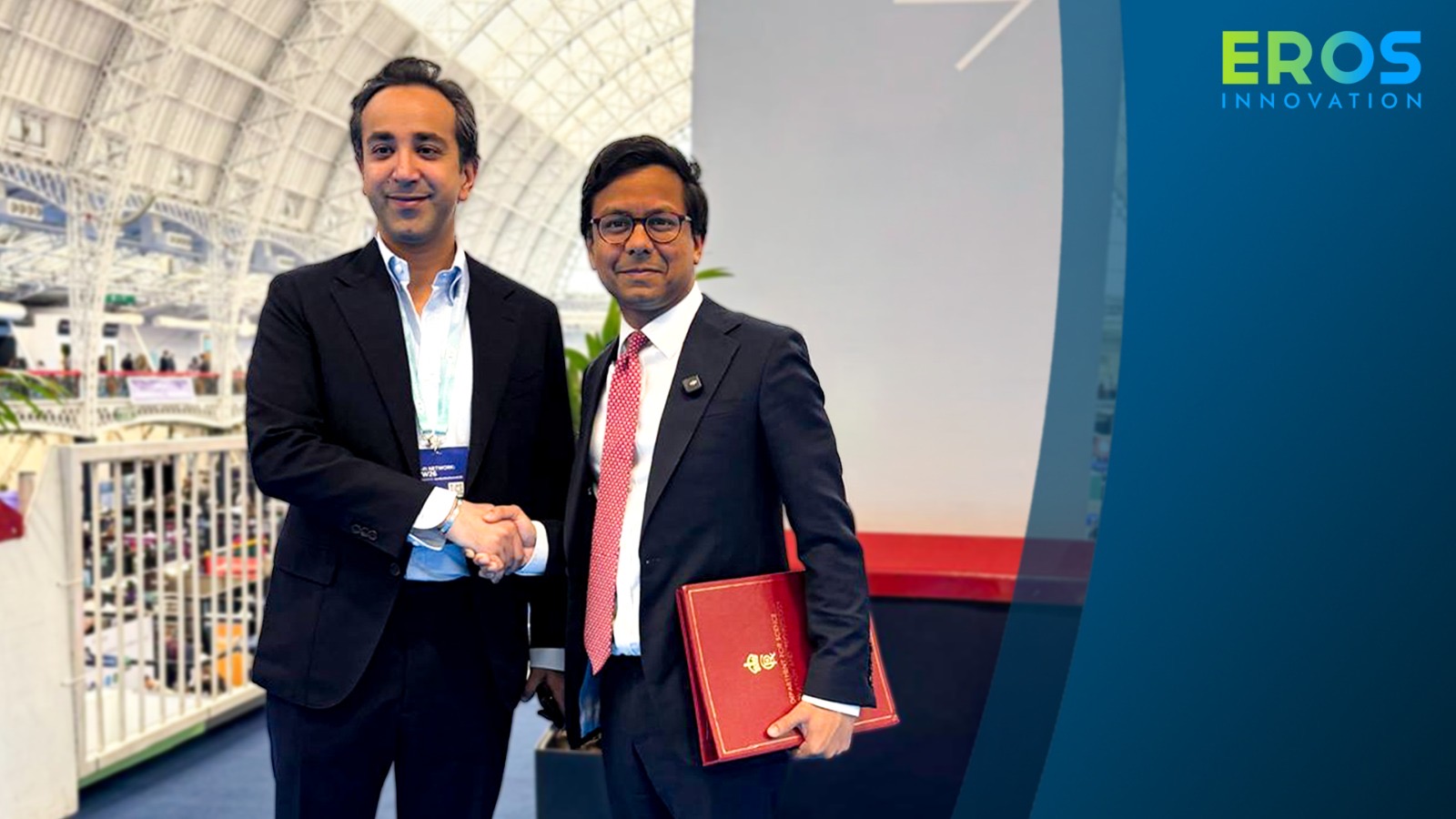
    Eros Innovation Licenses Cultural Dataset to UK Operation; £265 Million Committed to British Film Production

    At London Tech Week today, Eros Innovation announces three creative programmes, fifteen productions, and a £265 million commitment to the United Kingdom. Alongside this, Eros licenses its USD 1.7 billion cultural dataset independently valued by OxValue.AI in association with the University of Oxford, to its UK operation, establishing a sovereign-grade cultural artificial intelligence capability in Britain. This is one of the most ambitious cultural AI announcements ever made, and it begins in London.
     
    Eros Brahmand, showcasing a cinematic universe rooted in ancient Indian mythology, reimagined at franchise scale for global audiences, brought to life by a global collective of talent from India, the United Kingdom, Hollywood, Europe and Asia, and anchored within Britain’s renowned infrastructure. Eros Universe  six of the most beloved Indian film worlds continuing, each expanding into full franchise ecosystems spanning film, microdrama, animation and character-led content. Eros Remastered; iconic Indian cinema, reimagined through Cultural Intelligence. Together: fifteen productions, a sneak preview of the Brahmand universe, and one announcement.
     
    The Eros Brahmand trailer receives its world premiere at London Tech Week today, offering a sneak preview of the universe. Two productions from the group are confirmed to shoot in Britain in 2026: Nandi  War of Kailasa, and Tanu Weds Manu The Next Chapter, directed by Mitakshara Kumar (Heeramandi, The Empire) and co-produced with Rudrak Soma Jyoti Limited, with an exciting new cast.

    PART ONE — EROS BRAHMAND: A CINEMATIC UNIVERSE

    The first cinematic universe built on Indian mythology at global scale, rooted in the deepest seam of ancient Indian mythological tradition, reimagined at franchise scale. Each world carries its own mythology, character universe, visual language and narrative architecture. Each developed through a dedicated UK Film Production Company. Brought to life by a global collective of talent from India, the United Kingdom, Hollywood, Europe and Asia.
    1. Nandi – War of Kailasa, Shoots in Britain 2026
    2. Dwaarka: Gateway to the Universe
    3. Vimaan Wars
    4. Mahabharat 5000 A.D
    5. Yakshinis
    6. Brahmarakshak
    7. Garuda
    8. Kumbhayanna
    9. Mansa Devi

    PART TWO — EROS UNIVERSE: SIX CONTINUING WORLDS

    These are not remakes, they are the next chapters of stories that have never left the hearts of the people who love them. Each becomes a full franchise world: film, microdrama series, originals, animation and character-led content, powered by Cultural Intelligence, produced in the UK.
    1. Tanu Weds Manu – The Next Chapter, Directed by Mitakshara Kumar (Heeramandi, The Empire). Co-produced by Eros Universe and Rudrak Soma Jyoti Limited.
    2. Phobia
    3. English Vinglish
    4. Desi Boyz
    5. Rangeela
    6. Tere Naam
     
    PART THREE — EROS REMASTERED

    Kochadaiyan — Remastered.
    Starring Rajinikanth. Directed by Soundarya Rajinikanth. India’s most beloved superstar has entrusted his catalogue to the Eros Large Cultural Models, and his daughter, one of the leading voices in contemporary Indian cinema, is leading the creative reimagining. The first Indian motion capture film, originally produced by Eros, is brought back to life through Cultural Intelligence for a new generation of audiences.

    THE UK INVESTMEN  £265 MILLION OVER FIVE YEARS

    The £265 million commitment establishes London and the United Kingdom as the production, technology and creative home of all three Eros creative programmes. Every production is developed through a dedicated UK Film Production Company. The commitment covers: AI music studios in London; dedicated microdrama production; London-based animation; UK-based LCM training and R&D, with British academic partnerships currently in development.

    Eros Innovation has additionally licensed its USD 1.7 billion cultural dataset, independently valued by OxValue.AI in association with the University of Oxford, to its UK operation, establishing a sovereign-grade Cultural AI capability in Britain, aligned with India’s broader sovereign AI ambitions. The LCM family was first unveiled at the India AI Impact Summit, New Delhi, February 2026. The voice layer, Eros LCVM, launched on 5 June 2026, released by Shri S. Krishnan, Secretary, MeitY, Government of India.
     
    The programme directs inward investment, employment and research activity into the United Kingdom’s creative and technology sectors. It supports the development of cultural AI, an emerging field, within British institutions, and aligns Eros’s long-term creative production with UK talent, facilities and academic research.

    AI investment in Britain has typically taken the form of offices, research labs or compute allocation. This commitment is structural. The dataset is being licensed to and operating from the UK; the Eros AI Studio that runs on it is being built in the UK; the law that governs it is British. The result is data sovereignty, regulatory sovereignty, and an AI-native production capability anchored in Britain.

    For a decade the British creative sector has faced a structural question, who owns the means of production when the platforms sit overseas. This commitment is one answer: indigenous creative capacity, rights cleared at source, made and owned through UK production companies, with the value captured here rather than exported.
     
    LOOKING FORWARD — A GLOBAL CULTURAL EXCHANGE

    Looking beyond the immediate programme, Eros is exploring a Global Cultural Exchange framework enabling trusted interoperability between creators, institutions, archives and cultural ecosystems, preserving data sovereignty, rights protection and local governance. London is intended to play a central role.

    “India is a vital partner for the UK and we have huge ambition to unlock more opportunities together across key industries like AI, tech and the creative sector. This commitment by Eros Innovation is proof that we can aim higher, and go further, when we work together. It’s a vote of confidence in Britain’s creatives and our tech sector.”

     Kanishka Narayan MP, Parliamentary Under-Secretary of State, Department for Science, Innovation and Technology

    “What we are bringing to Britain is not an office, and it is not an investment. It is a sovereign-grade cultural artificial intelligence capability — one of the world’s largest rights-cleared cultural datasets, the AI Studio that will operate on it, and a long-term partnership with British data, British talent and British institutions to build what comes next together. Cultural AI will define the next decade of how humanity creates, learns and remembers. Britain is the right place to build it.”

     Swaneet Singh, Co-President, Eros Innovation

    “Storytelling has always evolved alongside technology, but the heart of every great story remains imagination, emotion, and human creativity. Through Eros Brahmand, Eros Universe, and Eros Remastered, we are building something that has never before been attempted at this scale, a new creative ecosystem powered by AI, rooted in culture, and designed to bring stories to audiences in entirely new ways. We are proud to be building it from London.”

    Ridhima Lulla, Co-Founder & Co-President, Eros Innovation; CEO, Eros Brahmand Studios

  • Evergreen Goodwill Brings Seattle Soccer Summer to Life with Custom Screen-Printing Events at the World’s Largest Goodwill

    SEATTLE, June 9:  As Seattle gears up for a global influx of soccer fans this summer, Evergreen Goodwill of Northwest Washington is inviting locals and visitors alike to experience a different kind of matchday energy—one rooted in creativity, community, and uniquely Seattle style.

    Just steps from Seattle Stadium, the Seattle flagship store—the largest Goodwill in the world—will host two special screen-printing events as part of its Seattle Soccer Summer celebration. Taking place June 19 and June 24 from 3–7 PM, these one-of-a-kind activations transform thrifted shirts into meaningful, personalized keepsakes.

    Designed by Seattle-based artist Hoa Hong, the limited-edition graphics draw inspiration from soccer culture and the global connections that define the sport—offering a wearable memory for travelers and a point of pride for locals. Each item will be screen-printed live on-site by The Vera Project, turning every piece into something personal, creative, and distinctly Seattle.

    For fans heading to or from nearby match watch parties, the events offer a natural extension of the day’s energy. Located a short walk from the Chinatown–International District, the flagship store provides an easy post-match destination at which to wait out the heavy traffic.

    Event Highlights:

    Limited-edition, soccer-inspired designs by Hoa Hong

    Live screen-printing with custom tees and totes made on the spot

    Curated selection of high-quality blank t-shirts to choose from

    Live DJ set from 3–5 PM

    A creative, community-driven atmosphere that reflects Seattle’s culture

    Beyond the experience itself, each purchase carries a deeper impact: Revenue from every sale supports Evergreen Goodwill’s tuition-free job training, education, and career placement programs across Northwest Washington—connecting a moment of creativity to long-term community benefit.

  • Goldin Announces Closing Night Live Event for the Spring Goldin 100, Featuring Karl-Anthony Towns, Jesser, and Ken Goldin

    The live event combines the closing night of Goldin’s flagship quarterly auction with grail-level collectibles and star-powered appearances at Goldin HQ

    June 9: Goldin, an internationally recognized auction house known for rare and record-breaking collectible sales, today announced the Spring Goldin 100 Closing Night Live Event which will take place at Goldin HQ (Runnemede, New Jersey) on June 28 starting at 9:00 PM. The event marks the closing night of Goldin’s flagship quarterly auction featuring exactly 100 elite, grail-level collectibles spanning sports, trading cards, pop culture, gaming, and history.

    Building on the success of Goldin’s Logan Paul Auction Closing Night experience, the event fuses live auction excitement, creator-driven entertainment, and a global livestream reaching collectors around the world. Confirmed talent for the evening include NBA All-Star Karl-Anthony Towns and Jesser, one of the largest sports and collectibles creators in the world with more than 44 million YouTube subscribers. Fans attending in person will also have the opportunity to participate in a Meet & Greet with the featured talent beginning. The evening will be broadcast live on Jesser’s YouTube channel and Goldin on eBay Live.

    Ahead of the event, Goldin will host a dedicated 2026 Live Box Break Event Auction, featuring 48 pack-slot lots now open for bidding. The auction went live Monday, June 8th at 12:00 PM ET, and will close Sunday, June 13th at 10:00 PM ET (extended bidding), with winning bidders earning ownership of packs that will be ripped live on stage during the June 28 event. Winners will also receive an invitation to attend in person at Goldin HQ with a guest, plus-one access, and the opportunity for a custom live-read shoutout. On June 28, those winning collectors will watch their packs opened live as part of the evening’s entertainment.

    The five featured products span some of the hobby’s most iconic eras. 1980 Topps Basketball (“The Origins”) offers collectors a shot at the legendary Larry Bird, Magic Johnson, and Julius Erving rookie cards serving as the evening’s vintage lottery ticket. 2003-04 Topps Chrome Basketball (“The LeBron Era”) features a shot at arguably the most recognizable rookie card in the hobby, a Lebron James rookie card alongside Dwyane Wade, Carmelo Anthony, and Chris Bosh. Also featured is 2018-19 Panini Prizm Basketball (“The Modern Superstar Era”), widely considered one of the strongest modern basketball products ever produced, headlined by Luka Dončić Rookie Silver, Gold Prizm, and Black Finite 1/1, with additional stars including Jalen Brunson, Shai Gilgeous-Alexander, and Trae Young.

    Representing the present day, 2025-26 Topps Chrome Basketball Jumbo features Victor Wembanyama Autos and Parallels, Cooper Flagg Rookies, and major rookie autos. Rounding out the lineup is 2018 Bowman Chrome Baseball (“Jesser’s Personal Chase”), featuring Shohei Ohtani rookie cards, Refractors, and Superfractors, and key cards of Ronald Acuña Jr. and Juan Soto.

    With a packed calendar of marquee auctions and live events, Goldin continues to be the premier destination for collectors this summer.

    Additional ongoing and upcoming auctions include the newly opened USA 250 Auction, the Global Football Auction, open through June 13, the Combat Sports Auction, open through June 15, the Spring Pop Culture Auction, open through June 17 and the Goldin 100, open through June 28.