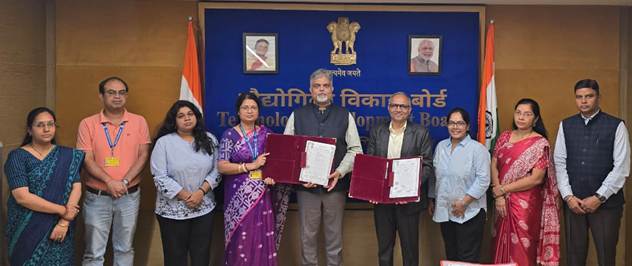

New Delhi, Nov 12: India has taken another step towards strengthening its indigenous space and strategic technology capabilities, with the Technology Development Board (TDB), under the Department of Science and Technology (DST), signing a ₹64.05 crore funding agreement with Bengaluru-based Astrome Technologies Pvt. Ltd. to develop a sovereign, artificial intelligence-enabled Electronic Intelligence (AI-ELINT) satellite constellation.
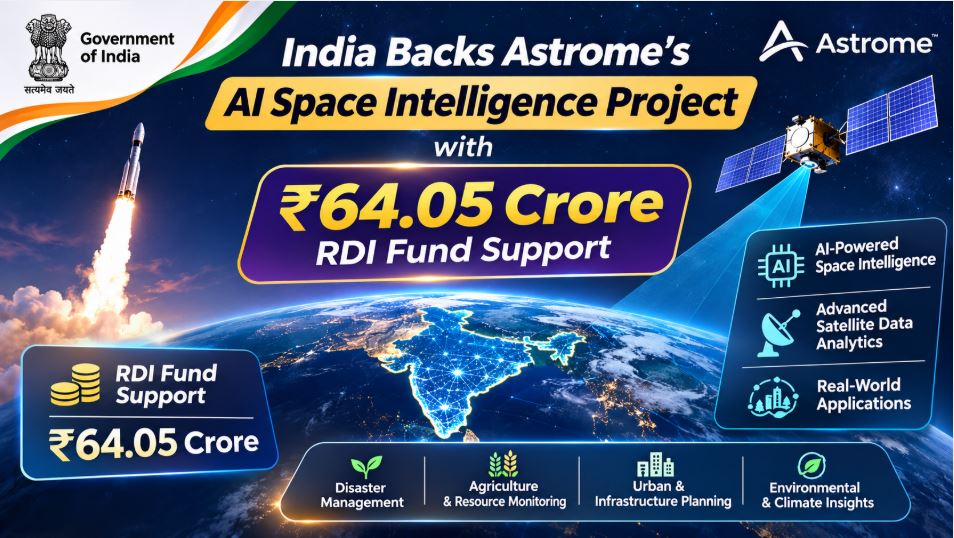
Representational Image
The project, valued at ₹128.11 crore, is being supported under the Government of India’s Research, Development and Innovation (RDI) Fund. The financial assistance will be provided through Optionally Convertible Debt (OCD), with the programme targeting the advancement of critical technologies from Technology Readiness Level (TRL)-4 to TRL-9.
The initiative aims to establish an indigenous space-based intelligence system designed to support national security requirements by integrating satellite-based electronic intelligence, AI-powered data processing and inter-satellite communication technologies.
Three core technologies to power the satellite constellation
The proposed AI-ELINT programme brings together three major technological components: an indigenous Electronic Intelligence payload, AI-based ground processing software and inter-satellite communication links.
Under the project, Astrome plans to develop AI-ELINT microsatellites in the 50-kg class, designed to operate collectively as a constellation in Low Earth Orbit (LEO). The network is expected to provide wider geographical coverage and more frequent observation of designated areas of interest as additional satellites are deployed.
The ELINT payload will form the intelligence-gathering component of the system, enabling the detection and analysis of electronic signals across a broad frequency range. Information collected through the satellites will be processed using dedicated AI-based ground software, with the objective of improving the speed and efficiency of data analysis.
Another important element is the development of inter-satellite communication links. These links will allow satellites within the constellation to exchange information and function as an integrated network, strengthening coordination and the overall operational capability of the proposed system.
Technology development to progress towards TRL-9
The project will cover the complete technology development cycle, including engineering, system integration, testing and validation. Its primary objective is to advance the core technologies from their current development stage, TRL-4, to TRL-9, representing a fully demonstrated system in an operational environment.
The initiative falls under the deep technology sector, with space technology identified as its primary sub-sector. It brings together advanced capabilities in satellite engineering, electronic intelligence, artificial intelligence and secure space-based communications.
The proposed constellation architecture is intended to progressively improve coverage and revisit frequency as the satellite network expands, supporting the development of an integrated indigenous space-based intelligence capability.
TDB highlights India’s growing deep-tech potential
Commenting on the agreement, TDB Secretary Rajesh Kumar Pathak said India’s expanding capabilities in space technology are creating new opportunities to develop advanced systems through indigenous engineering, artificial intelligence and next-generation communications.
He emphasised that developing complex technology platforms requires sustained innovation, rigorous testing and long-term investment. Through the RDI Fund, TDB is supporting Indian enterprises engaged in frontier technologies that can strengthen the country’s strategic technological capabilities.
He described the partnership with Astrome as an example of the potential of India’s deep-tech ecosystem to develop sophisticated space-based solutions for emerging national requirements.
An authorised representative of Astrome Technologies said the financial support would accelerate the development and integration of critical technologies for the company’s AI-enabled space-based intelligence programme.
The representative noted that combining indigenous ELINT payloads, AI-driven data processing and inter-satellite communications would help the company build an integrated constellation capability to address emerging requirements in the space and national security domains.
Boost to India’s sovereign space technology ambitions
The agreement highlights the growing role of domestic deep-tech companies in developing advanced space systems and reducing dependence on external technology platforms.
By supporting the development of indigenous satellite payloads, intelligent data-processing systems and space-based communication technologies, the project seeks to strengthen India’s ability to design, integrate and validate sophisticated space infrastructure within the country.
With the RDI Fund providing financial backing for high-technology innovation, the Astrome partnership represents a significant push towards translating advanced research and engineering into operational indigenous capabilities.